Burma keen to prove it's open to foreign investors
SPECIAL REPORT: Thai delegation visits Dawei today in an effort to strengthen confidence in an ambitious scheme
- Published: 7/01/2012 at 12:00 AM
- Newspaper section: News
The trip by the Thai ministers of foreign affairs, finance, industry, energy and transport to Dawei today is seen as an attempt to bolster confidence among prospective investors for the mega-project and to send a message to the international community that Burma is serious about opening up the country.
The visit was arranged after two requests from Burmese President Thein Sein to Prime Minister Yingluck Shinawatra.
Italian-Thai Development Plc (ITD) has been granted a 75-year concession for the special economic zone in Dawei that covers 250 square kilometres, 10 times bigger than the Map Ta Phut Industrial Estate in Rayong.
The deep-sea port of 6,100 rai of land alone is five times the size of Laem Chabang port in Chon Buri.
Transport Minister Sukumpol Suwanatat reaffirmed Thai support for the port construction and another five projects there as it is a showcase of Thai investment in Burma.
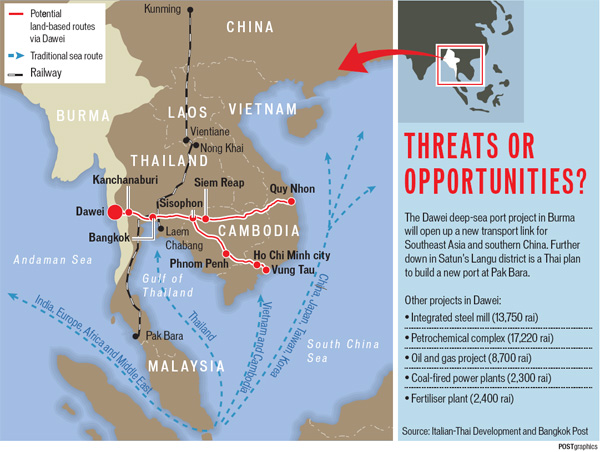
Dawei is about 300km from the Thai border province of Kanchanaburi. Part of the industrial development plan is to build a land transport link with Thailand and other mainland Southeast Asian countries, making it a key industrial site and port for the region.
The project is part of the Southern Economic Corridor under the Greater Mekong Subregion initiative.
But turning the project from a blueprint to a reality may be a challenge, says Chula Sukmanop, an expert on logistics at the Transport Ministry. Investors will take into account political factors in Burma while calculating their business risks and gains.
"Political stability is one of the conditions for investors," Mr Chula says.
Burma realised this problem and tried to build foreign investor confidence in the project by issuing the Dawei Special Economic Zone law last year. The law is to assure foreigners that their investments would be guaranteed in case of any political change in Burma, a Thai government source familiar with the project noted.
ITD chairman Premchai Karnasuta said recently that the company was targeting loan deals of at least US$12.5 billion (387 billion baht) this year to finance key projects in Dawei. These include $3.5 billion for port and road construction, $2 billion for a rail project and $7 billion for coal-fired power plants with a combined capacity of 4,000 megawatts.
The contractor has been in talks with the Japan Bank for International Cooperation for loans to finance the port and road development, while Chinese lenders are keen to provide funding for the rail project.
The firm plans to conclude financial agreements for an integrated steel mill, oil and gas facilities, petrochemical complex and fertiliser plant projects as well as a selection of its strategic partners this year.
ITD also plans to sell 50,000 rai, or 30%, of the total area in Dawei next year. Proceeds will be used to finance the six priority projects.
Although Dawei is intended to serve industries in the zone, it can be developed into a key port to avoid sea lane traffic congestion in the Malacca Straits. It can shorten the travelling time of cargo ships from Southeast and East Asia to markets in Europe and the Middle East. The land transport will link Dawei with other ports in Thailand and Vietnam.
"Many countries such as Japan and China are paying attention to this route due to its potential and it could be a production base for them. The Southern Economic Corridor is important in terms of economic benefits," the source said.
Foreign Minister Surapong Tovichakchaikul said the port will bolster the connections of members of the Association of Southeast Asian Nations and its partners China and Japan.
Thailand is also considering building a deep-sea port at Pak Bara in Langu district of Satun for exports from Thailand and China, with the same goal of bypassing the Malacca Straits.
The Pak Bara project has been on and off since the first study seven years ago due to environmental concerns as it will be built in the Petra National Marine Park.
ACM Sukumpol and Mr Chula see no threat from the Dawei port to Pak Bara because of their different purposes. The Dawei deep-sea port is built to feed raw materials to other projects there, while Pak Bara will be exclusively developed for imports and exports, they said.
An advantage of Pak Bara is it will have a land link between the Andaman Sea and the Gulf of Thailand, as well as a rail connection to China, according to the transport minister.
The Pak Bara project will be considered after the completion of the rail link between Thailand and China via Laos, ACM Sukumpol says.
But Mr Chula cautioned that the Dawei deep-sea port could emerge as a rival to the Thai port in the next 10 years.
"The Dawei deep-sea port and the Pak Bara deep-sea port will target different markets but Thailand has to be prepared," he said.
Tanit Sorat, vice-chairman of the Federation of Thai Industries, said the Dawei port is an ambitious plan. It positions itself as a global port to compete directly with those in Malaysia and Singapore, he said.
The port could be a western gateway for Thailand, which has no clear policy on a deep-sea port for the western coast.
"I think Dawei could be an option for Thai investors," Mr Tanit said, citing such upstream industries as oil and gas or steel to be developed there, plus the need to relocate to flood-free areas and away from the planned hike of the minimum daily wage to 300 baht.
"By the time Dawei is in operation, industries in Thailand will be much more advanced than today," he said. "Thailand will move away from heavy industries such as petrochemicals and leave them to neighbouring countries."
No comments:
Post a Comment