Showing posts with label PORTS. Show all posts

Thursday, February 8, 2024

 The Organisation of Ports in Sabah

Port operations are a vital component of maritime trade, with compliance in environmental and safety practices being paramount for sustainable operations. Port operations constitute an essential pillar of Sabah's regional economy, prominently featuring Sabah Ports Sdn. Bhd. and POIC Ports as key players. In Sabah, the regional economy is heavily reliant on port operations. Their licensing agreements set the foundation for their operations, roles, and responsibilities.

Ports in Sabah are organized and managed to cater to various types of maritime activities, ranging from container handling to oil and gas services as well as palm oil products. The landscape of port management and operations includes both publicly managed and private ports, reflecting a blend of government oversight and private sector efficiency aimed at enhancing the state's maritime infrastructure and trade capabilities. Private ports in Sabah, often specialized and developed to cater to specific industries or economic zones, play a crucial role in the region's economic development.

Aside from a defined ports structure as being either a public or a private port, there are also proliferations of what are termed as 'Private jetties' in Sabah to serve a variety of purposes, ranging from supporting the operations of specific industries to providing access for private resorts and tourism activities. These jetties are essential components of Sabah's maritime infrastructure, facilitating efficient transportation and logistics, particularly for sectors such as palm oil, timber, aquaculture, and tourism.

Sabah Port Authority Enactments

The Sabah Ports Authority within the context of its Enactment (17 of 1981), act as the landlord of all wharves, servicing ships on a common-user basis, and oversees warehouses that serve as transit storage for goods. The Privatisation Enactment (2 of 1998) marks a significant shift in the management of Sabah’s ports, redefining the Sabah Ports Authority (SPA) from a direct operator to a regulatory and oversight body.

Privatisation Agreements

The Sabah Ports privatisation agreement refers to the transfer of operational rights and responsibilities of ports in Sabah, Malaysia, to a private entity. This process typically involves the government of Sabah entering into an agreement with a private company, allowing the company to manage, operate, and possibly develop the ports in exchange for a concession period. The objectives of such privatisations are often aimed at improving efficiency, attracting private investment, enhancing port infrastructure, and providing better services to port users.

The privatization agreement has significantly transformed the operational landscape of Sabah's ports, redefining the roles and responsibilities of the Sabah Ports Authority (SPA). As the regulatory body, SPA's functions have been adjusted to focus more on oversight, strategic planning, and policy development, ensuring that port operations align with broader economic and environmental goals.

Regulatory Oversight

SPA's paramount role involves establishing comprehensive regulations and standards to govern port operations, focusing on efficiency, safety, security, and environmental protection, ensuring all port operators comply with these standards.

Strategic Planning and Policy Development

SPA engages in strategic planning and policy development to guide the growth and development of port infrastructure and services, aligning with broader economic and developmental goals.

Licensing and Concession Management

The authority is responsible for issuing licenses to port operators and managing concessions, ensuring that these entities meet the operational, safety, and environmental standards set forth by SPA.

Infrastructure Development Oversight

SPA oversees and approves major infrastructure development within ports, ensuring projects align with strategic objectives and operational requirements, and meet the future demands of trade and logistics.

Environmental Protection and Sustainability

SPA enforces environmental standards, promoting sustainable practices among port operators to minimize ports' environmental impact and ensure compliance with national and international environmental guidelines.

Safety and Security Enforcement

Ensuring the safety and security of ports and maritime operations falls under SPA's remit, including the implementation of security protocols in line with international maritime security standards.

Stakeholder Engagement

SPA plays a crucial role in mediating and facilitating dialogue and collaboration among various stakeholders, including port operators, government bodies, and local communities, to ensure port operations are aligned with public and economic interests.

Monitoring and Performance Evaluation

SPA monitors the performance of port operations, conducting evaluations to ensure port operators meet efficiency and service quality benchmarks, and taking corrective actions when standards are not met.

Privatised entities

In Sabah, two distinct entities have come under a concession agreement with Sabah Ports Authority, i.e., Sabah Ports Sdn. Bhd. and POIC Ports playing significant roles. Their licensing agreements set the foundation for their operations, roles, and responsibilities.

Legal and Regulatory Framework

Sabah Ports Sdn. Bhd. operates under a comprehensive licensing agreement that outlines its duties and rights in managing several ports across Sabah. This agreement is regulated by the Sabah Ports Authority.

POIC Ports, particularly in Lahad Datu, are governed by a different set of agreements and regulations, tailored to the specific industrial and developmental goals of the Palm Oil Industrial Cluster (POIC).

Scope of Operations

Sabah Ports Sdn. Bhd. is licensed to manage a wide range of port operations, including container handling, bulk, and liquid cargo, and providing logistic solutions.

POIC Ports have a more focused operational scope, primarily supporting the palm oil industry and related sectors, including the facilitation of raw materials and processed goods.

Roles and Responsibilities

Sabah Ports Sdn. Bhd. is responsible for ensuring the efficiency, safety, and security of port operations across its managed ports.

POIC Ports have a unique role in integrating port operations with the industrial needs of the POIC, emphasizing on facilitating the export of palm oil products and related commodities.

Compliance and Standards

Both entities are required to comply with national and international maritime standards, but POIC Ports may have additional compliance requirements related to environmental and industrial standards due to their specific focus on the palm oil sector.

Impact on Regional Development

Sabah Ports Sdn. Bhd. plays a crucial role in general economic development, enhancing trade and connectivity for a broad range of industries in Sabah.

POIC Ports are strategically important for the development of the palm oil industry and related sectors, contributing to job creation and economic diversification in targeted regions.

Challenges and Opportunities

Sabah Ports Sdn. Bhd. faces challenges in managing diverse operations and meeting the growing demands of international trade. Opportunities lie in expanding port capacities and enhancing technological integration.

POIC Ports encounter specific challenges related to industrial growth and environmental sustainability. There are significant opportunities in leveraging the growth of the palm oil industry to expand port and logistic services.

As an overview, the licensing of Sabah Ports Sdn. Bhd. and POIC Ports reflects their distinct roles in Sabah's maritime and industrial landscape. While Sabah Ports Sdn. Bhd. is focused on a broad range of port operations essential for the state's overall economic development, POIC Ports are specialized, aiming to support and stimulate the growth of the palm oil industry and related sectors. Understanding these differences is crucial for stakeholders to navigate the opportunities and challenges within Sabah's maritime and industrial sectors effectively.

Summary

Under the Privatisation Enactment, SPA's functions and responsibilities have evolved to ensure that the privatization of port operations aligns with Sabah's strategic interests. Through regulatory oversight, strategic planning, and stakeholder engagement, SPA ensures that privatized ports operate efficiently, safely, and sustainably, contributing to the region's economic development and competitiveness in the regional maritime industry.

As for private jetties operations in Sabah they continue to be under license given by SPA. Some of them will graduate into a full bloom private ports depending on the nature and volume of trades managed. A couple may be fully operated commercially as a public port looking at the future of the economy of Sabah taking advantage of development within the BIMP-EAGA Regions especially on the move of the Indonesian capital to Nusantara in East Kalimantan. END.


Seaport as a Logistics and Industrial Node in Global Supply Chains

 Seaport as a Logistics and Industrial Node in Global Supply Chains 

Quoting a study entitled ‘Institutions and Industrial Development in Sabah’, published in 2022 by Firdausi Suffian, Kasim Mansur, Ika Suzieana Jamluddin, Arnold Puyok , and Azmi Abdul Majid, I found several phrases that are of profound importance when discussing about economic reforms. These are that:

i.                Industrialization is the key to structural change.

ii.              The institutions embedded with political consideration and private interests somehow has constrained the state to implement effective industrial policy.

iii.             There is scant attention on the role of institutions to take centre stage in analysing in economic growth and development.

iv.             Institutions are widely known as “rules of the game” in a society.

v.               Industrial development has wide sectoral interlinkages that have the capacity to pull the rest of the economy in all sectors.

In the foregoing article, these phrases are of profound importance when discussing the role of ports in the economic development of any country. The port as an institution are critical enablers and catalyst of the speed and impact it makes to the state economy. The critical role of the port as an institution towards the management of the economy is what spurs me to introduce the subject matter for a better understanding of its roles and functions and eventual responsibility to the state.

Seaports are points of convergence between the land and the sea of passengers and freight activities. While the marine side can involve huge geographic coverage related to global trade, the land side is related to the region and locality of ports.


Ports handle high volume of freight, as against other type of terminal combined.

The emergence of civilisation saw the start of trade networks which later require ports as its outlets. Ports have played a crucial role in facilitating trade and commerce across the world ever since. Although maritime transport technology has much evolved, the role and function of ports basically remain the same. Ports serve as gateways for international trade, connecting countries and regions across the world. They play a vital role in the global economy by generating employment opportunities and contributing to the growth of various industries.

It’s fascinating to see how seaports have evolved over time, and it will continue to play a critical role in shaping the future of our world. 


A port is traditionally defined as a transit area, a gateway through which goods and people move from and to the sea. It is a place of contact between the land and the sea that is termed as a node where ocean and inland transport systems interact, and a place of convergence for different transportation modes. Since the sea and inland transportation modes have different capacities, the port assumes the role where cargo is consolidated or deconsolidated, known as a load breakpoint.


In general, ports are classified into two categories, seaports, and inland ports.


The ports are diverse in sizes and functions. Ports also have a geographical diversity in terms of the sites being used for port activities such as rivers, bays to offshore locations and now a truly port on land called inland port.


The ports can be described from a supply chain perspective as being, ‘A seaport is a logistics and industrial node in global supply chains with a strong maritime link with clusters of activities directly or indirectly linked to transportation and logistics processes within global supply chains.’


Defining the Seaport

A modern seaport is not solely considered as a load breakpoint in various supply chains but should be considered a value-adding transit point. As nodes within transportation and logistics networks, ports have a location, whose relative importance can fluctuate given economic, technical, and political changes. This location capitalises on the advantages of a port site characterised by fundamental physical features influencing the nautical profile, such as water depth, access channels, and availability of land.


Categorisation of Seaports

The diversity of ports can be ascertained by their classification into various types of ports according to their specific role and functions. Ports can be categorized based on many dimensions, such as:


Scale. Refers to port size in terms of its area, annual cargo throughput, the size of its hinterland, the number of shipping services it is connected to, or the number of customers. The scale of a port is commonly associated with its economic and commercial importance in the market it serves.


Geographical attributes. Refers to the main characteristics of the port site and situation. There are various locational setting of port sites, such as in a bay, along a coastline, on a river, or in an estuary. Many sites have natural advantages, while for others, the site needs to be improved with dredging and landfills. Although a port site is fixed, its situation is relative to the main shipping lanes and hinterland, or its proximity to and interactions with cities or urban areas it served.


Governance and institutional settings. Refers to the terms of land ownership and the roles of institutional arrangements between the public and private sectors. Many ports are publicly owned but have terminals operated by private organizations.


Port functions. Refers to the range of services offered by the port, such as cargo handling, logistics, and distribution, industry, and maritime services. They are subject to competitive elements since the services offered by one port can be offered by another port.


Specialization. Refers to the cargo handled, such as containers, conventional general cargo, liquid bulk, dry bulk, or roll-on-roll-off cargo. Some ports are specialized in handling passenger traffic, namely cruise ships and ferries. Another specialization is based on port-centric industries such as steel plants, energy plants, automotive, or chemical industries. Logistics activities are also an important contributor to port specialization.


Ports serve a derived demand that can be segmented into specific markets. These markets include cruise ports and terminals, the break-bulk market, ports as complexes supplying and distributing energy, the provision and management of containers, and the cold chain technology that has allowed ports to play an active role within these supply chains, particularly with refrigerated containers (reefers).


One of the main driving forces of change in the port industry emerges from globalization and the shift from supply-driven to demand-driven economies. The supply-driven economy was based on economies of scale in production, standardization, and mass consumption of standard products. This approach changed as a growing individualism began to have an impact on consumption patterns. This brought about a shift to a more demand-driven economic system, combined with global production networks on the supply side of the markets.


I hope this information has provided some insights into the characteristics of seaports and is intended for educational purposes in helping to disseminate knowledge and awareness of the important function of a port in any economic development. We shall explore how our local ports in Sabah fare within the context discussed above in a future article. Seaports play a crucial role in the economic development of Sabah and reportedly the port operations in Sabah generated 90.1% of the operating ports total revenue in 2020   END.


Illustration:

A diagram of a port

Description automatically generated                                                                                    

Friday, August 4, 2017

Sapangar Bay Container Port as National Load Centre to cure Sabah's shipping woes

Sapangar Bay Container Port as a national load centre to cure Sabah's shipping woes

Issues on cabotage has gone quiet for a while. The last that was heard from the Authority is the announcement on exemption to the Cabotage Policy with a lukewarm response from those that has interest in them in Sabah and Sarawak. It has in fact amused the public that there was no details on the mechanism for implementation. What was received from the Ministry of Transport is that, 1.the Prime Minister upon his announcement of the Cabotage Policy Exemption on May 7, 2017, did not set any time frame for the implementation of the exemption. 2. the Minister of Transport also did not set any time frame for the exemption, and 3. that towards this end, the Ministry of Transport has set up a Task Force to assess the effect and impact of the exemption of the Cabotage Policy. These findings will be used as basis for assessment of the effectiveness of the exemption. The assessment exercise is expected to take at least a year.

Looking at it from Sabah's perspective, the author is not at all confident that the Authority will move forward to abolishing the cabotage policy on a probable account that the ship owners association will make a very very strong representation to protect the benefits that they have received as a member of the association, though the public may dispute this that it is time to end the preferential treatment that they have been receiving of which taxation is one that makes for the best part of these benefits which in return there is nothing to show from the association in respect of improving shipping fleets as part of the deal.

The Authority will also be hard pressed to trade off the national interest aspect of the policy in which shipping fleets will be available to the government to make use in time of emergencies where these commercial fleets can be commanded to carry supplies and people as the need be. Sabah for that matter will have to respect this clause in the Ordinance of 1952, that it may help Sabah to resolve issues as it affect them during emergencies.

With the above situation what chance has Sabah got to ensure that its economy can be boosted as a result of the situation that cabotage policy has apparently and in part caused their product becoming uncompetitive for overseas market. I would say lets kiss the issue goodbye and focus on a practical and proven solution to attract shipping activities into Sabah water.

There are basically three interest groups that shipping services and statistics will impact upon in Sabah. They are the ports (Sapangar Bay Container Port specifically), the manufacturers and the government.

Sapangar Bay Container Port
Sapangar Bay Container Port (SBCP) strength is its strategic location along the maritime silk route on the South China Sea. It is midway between the Far East countries and Singapore and Peninsula Malaysia. It can be turned into a transshipment hub for cargoes destined for the East Indonesian market, the Pacific belt and down south to Australia and New Zealand. It is a perfect location for the BIMP-EAGA market.

SBCP is affected in a way that with or without cabotage policy ships will shy away from coming. Although direct shipping services by foreign vessels can visit SBCP even under the cabotage rule, they can only carry such numbers of containers that is required of the Sabah market. However the coming of the ships has to be balanced by the number of containers that they are able to bring back on its return voyage. It has been proven that there is no sufficient numbers that can justify a balanced cargo load for making the trip. What has happened is that, the ship may come but the journey to Sabah can be costly to justify the cost of the voyage. Importers may have to be charged a penalty equivalent to perhaps double the freight cost taking into account the nearly empty load on its return journey. SBCP needs the volume to be considered worthy as a premier port. It can take its time to build on this but it will also take that long for the industry at the backyard to prosper as they depend on the port as their outlet to the market. The question therefore, is there a way to get  those numbers of containers fast?

The answer is YES, not relying on the laws but on a practical solution that has been proven to work. The answer is declaring SBCP as the National Load Centre for cargoes that is carried by ships on the South China Sea route for the Asian market. The Asian market comprises of the groupings or regional cluster of countries of The Far East markets, East Asean region and also the BIMP - Eaga region. These clusters has its own market for the container trades. The capability of the port to handle the number of cargoes that is derived from the cluster will determine which cluster that can best suit the volume that can be effectively handled by SBCP.

On a general assumption, the cluster of the Far East countries comprising China, Japan, Korea and Taiwan will be too large for SBCP to handle in the near future when the expansion project is completed in 2020. SBCP on completion is only forecasted to handle slightly over 1 million teus. The cargoes generated for the far east market account for more than 2million teus. Since it is a big market we have to allow for the freedom of choice for the market to determine which port to use. Ships and shippers are free to choose if to use SBCP or Port Kelang in this situation. A lesser tonnage which will come from the cluster of countries in the East Asean region which comprises basically the Indochina countries of Vietnam and Cambodia, those cargoes generated from the eastern port of Thailand that is port like Laem Chabang and also from the Philippines. It is safe to assume that the cargoes from this cluster will be ably handled by SBCP.

The other cluster comprising of the BIMP-EAGA countries may well be too small a number if this cluster is considered for its cargoes to be handled by SBCP. Further this market has not been fully developed for trading amongst member countries to be commercially realised.

The National Load Centre
National load centre status had been conferred on Port Kelang way back in 1993 via a Ministerial Directive coming from the Minister of Transport. The effect is to cause all cargoes for shipment from the various ports in the country to be shipped via Port Kelang so that there will be a marked improvement of the number of containers handled whilst at the same time each ports will and is free to handle its own container cargoes meant for foreign destinations. The objective of this Directive is to enable Port Kelang to catapult to a higher ranking position in a list of world's busiest ports. This they did and they are now in 12th position and Port of Tanjung Pelepas at 19th position.

Port Kelang has now outlived the necessity of having to rely on the Directive as through the years they have developed their niche market that will enable them to retain their 12th position or so in the world ranking. Will one million teus extracted out of their statistics hurt them? No, as this statistic will still feature in their books only that it may appear in a different category for example either as export or transshipment cargo.

Now to help Sabah's economy to grow, SBCP need the one million teus to enable them to achieve a hive of shipping activities in the shortest possible time to help spur its manufacturing industry, and not rely on building blocks one at a time where it may take a long time to realise the dream of generating this volume of cargo. This reminds us of how Port of Tanjung Pelepas came into being as an international status port with the injection of two million teus brought by Maersk Line when it shift its operation from Singapore. This was immediate. We hasten to think how long would they achieved this status if there was not an immediate injection of the two million teus. The concept is the same here for Sabah. An immediate injection of a sizable volume of container cargo will immediately transform SBCP port to an international status and at the same time spur the economic development of its backyard and manufacturing sector.

Will a Ministerial Directive be had for Sabah? The beauty of this directive is that it doesn’t hinge on the cabotage policy as domestic cargoes will be carried by Malaysian registered ships from ports in Peninsula Malaysia to Sabah and vice versa and the shipment out of Sabah will be a direct shipment to foreign destinations well within the context of cabotage policy. Sabah will therefore be able to operate as a transshipment hub. We take note that cabotage policy does not preclude or prescribe any vessel to make port calls in any port in Malaysia.

With a huge economic potential availed for Sabah as a result of increased shipping activities, investment into the state will also increase and more so for investment for port equipment to enhance its performance to meet new demands and needs due to increased shipping activities.

The Manufacturers
The manufacturers woes is that their product has become uncompetitive overseas as the freight they paid is excessively high due to uneconomic operation of ships without a balanced cargo for both end of the journeys causing the shipping company to charge a higher rate for the container going one way. This means that the freight from say Japan to Sapangar Bay is charged at a higher rate to justify for economics of operations for less than cargo load carried. As is the current situation shipping their products via Port Kelang attracts a far costly freight since there is an element of double handling of the container when it reaches Port Kelang and also the fact is that by going through Port Kelang it will be covering a greater distance compared to shipping it direct from SBCP to the Far East market since distance wise it is much nearer. Journey wise it is tantamount to doubling back to SBCP before proceeding to its destination.

How will the national load centre concept work for them? With increased number of ships plying in and out of SBCP, there is no more issue of penalty to be imposed as there are enough load to carry to and out of SBCP. This will generate increased production for the products and also generate other economic activities for the export market. This is an immediate direct injection of interest in the manufacturing sectors in Sabah arising from an immediate availability of shipping space. If the port were to take its time in coming up with the targeted number of containers to be handled, it will also take time for the manufacturing industry to be rejuvenated.

The State
With increased and improved port performance on handling of arrivals of more ships will denote a vibrant economy. A vibrant economy will attract more investments for the benefit of the state economy.

A national load centre as a concept is the answer to the survival of the state economy especially the manufacturing sectors for both downstream and standalone projects. Reliance on tourism alone as the source of state income and of shipment of crude and raw materials will not provide a broader base for the state economy and therefore lacking in a solid platform for economic survivability.

It will not hurt ship owners in Malaysia as they will still be in business to carry cargoes from within the Malaysian ports. What we need is for ships foreign and domestic alike to bunch into SBCP to create the hives of shipping activities which will allow our local products to be shipped directly to East Asian and including the Far East markets much more cheaply than before. At the same time with opportunities such as this being available for our exporters more investments will pour in to take advantage of this situation and creating more export products and a healthy state economy.

Ramliamir is a member of the Chartered Institute of Logistics & Transport Malaysia. He can be contacted at ramliamir@cilt-m.com.my

Monday, December 10, 2012

SHANGHAI PORT KEEPS ON ROLLING


Shanghai throughput up for third straight month
                
Shanghai Port, the world's busiest container port, saw its container volume rise 7.6 percent in November from a year earlier, the third straight month of gains, data issued by the port's operator showed, reported Reuters.Container throughput reached 2.82 million TEUs, up from 2.72 million in October. The year-on-year increase for the month compared with a rise of 1.4 percent in October.Economists polled by Reuters expect annual export growth to slow to nine percent from a rise of 11.6 percent in October, while annual imports growth are seen easing to two percent last month from October's 2.4 percent increase.

Thursday, November 29, 2012

THE RISE OF SHENZEN PORT

Shenzhen port tipped to overtake HK in 2012 


Shenzhen port is forecast to handle 25 million TEUs this year while 
Hong Kong throughput is likely to be around 23.5 million TEUs


Shenzhen is set to overtake Hong Kong as the world's third-busiest container port this year for the first time ever on an annual basis. 

This comes as total box volumes through Shenzhen's four main facilities have continued to climb despite the downturn in global trade, reported the South China Morning Post. 

By comparison, volumes through Hong Kong have dropped, especially from river trade and barge business. 

Hong Kong is set to handle about 23.2 million TEUs this year, according to Post estimates based on throughput figures between January and October. The full-year estimates take into account the expected slack trade season in November and December. 

Industry observers supported the estimates. Jon Windham, head of the Asian industrials equity research at Barclays in Hong Kong, forecast the port would handle 23.5 million TEUs in 2012. By comparison he thought Shenzhen would pull pass Hong Kong to handle 25 million TEUs. 

Sunny Ho Lap-kee, executive director of the Hong Kong Shippers' Council, added: "Your calculation might be right. [The] forecast is far from good." 

Alan Lee Yiu-kwong, head of the Hong Kong Container Terminal Operators Association, said: "Yes, we are losing out". He said Shenzhen would certainly overtake Hong Kong next year if it failed to do so this year. 

Lee pointed out that Hong Kong had technically lost the No 3 spot for several years because 60 per cent of Hong Kong's container volumes is transhipment cargo. As a result each container is counted twice. 

He said container traffic through Shenzhen, Guangzhou and other south China ports are "practically all direct shipments". This meant each container is only counted once. 

Latest figures from the Port Development Council show Hong Kong handled 19.4 million TEUs in the first 10 months of 2012, down 4.4 per cent compared with the same period last year. 

While container volumes grew by a marginal 0.8 per cent to 14.6 million TEUs at the nine Kwai Chung container terminals between January and October, throughput slumped 17.2 per cent to 4.8 million TEUs at facilities outside Kwai Chung. 

Windham forecast that Shanghai would remain the world's top container port this year, handling 34.9 million TEUs. Singapore would be in the No 2 spot with 31.6 million TEUs. 

Saturday, June 2, 2012

PORT PERFORMANCE


CMIT sets productivity record for Vietnam

Cai Mep International Terminal (CMIT) this month set two important new productivity benchmarks for container terminals in Vietnam.

While handling Maersk Line’s vessel, the 9,038 TEU Mette Maersk, CMIT moved 2,100 containers during an 11 hour, 30 minute port stay.

Gross crane productivity was 43 container moves per hour, resulting in berth productivity of 183 moves per hour.

“This is certainly the first time CMIT has crossed the important benchmark of 40 crane moves per hour, and we believe we are the first container terminal in Vietnam to have done so”, said Steen Davidsen, CMIT’s general director.

“We also believe our berth productivity of 183 moves per hour using just 5 Ship-To-Shore cranes sets a new benchmark for Vietnam” he added.

CMIT measures berth productivity based on the total time the vessel is available for work on the berth starting from the time the gangway is secured and ending upon time of vessel sailing or half an hour after operational completion should the vessel not sail immediately upon completion.

Time is never deducted from this berth productivity calculation so CMIT’s berth productivity is a true reflection of the time the vessel spends working at the terminal.

“Terminal berth productivity is a critical cost driver for all shipping lines, and high berth productivity translates directly into significant bunker cost savings for us,” said Peter Smidt-Nielsen, general director of Maersk Line, Vietnam.

“Achieving the levels of productivity being delivered to Maersk Line by CMIT is quite remarkable – and particularly so for a terminal that has been operational for just 14 months.”

CMIT handled its first vessel on March 30, 2011, and since then has welcomed 151 vessel calls, handling over 351,000 TEU of export and import containers to and from Vietnam’s major trading partners in Europe, North America and Asia.

Monday, May 7, 2012

PORT OPERATOR TO OWN GARMENT BIZ

Port operator ICTSI takes over garment firm 

Port operator International Container Terminal Services Inc (ICTSI), through its Singaporean unit, has acquired a controlling stake in an Indonesian garment manufacturer, reported Business World.

In a disclosure, Philippines’ ICTSI said its subsidiary ICSTI Far East has amassed an 80 percent stake in Karwell Indonesia.
ICTSI Far East yesterday bought over 312 million shares in Karya Estetikamulia, the controlling shareholder of Karwell, for some US$2.5 million. This gave the ICTSI unit an initial 53.23 percent stake in the garment maker.

"In addition to the acquisition on May 3, ICTSI Far East also executed the purchase of 157,172,500 shares of Karwell or equivalent to 26.77 percent that are owned by several parties from the public shares," the disclosure read further.

ICTSI Far East also owns New Muara Container Terminal Services, which operates the Muara Container Terminal in Brunei, and Makassar Terminal Services, which operates container-handling equipment at the Makassar Container Terminal in South Sulawesi.
The acquisition follows the purchase by ICTSI Mauritius of a 35 percent stake in Pakistan International Container Terminal. (PICT).

PICT, which is located at Karachi port, has a maximum handling capacity of 750,000 TEUs.

ICTSI chairman and chief executive Enrique Razon, said last month that the company is also looking to acquire more port concessions in Africa, Middle East, and Latin America.

As of 2011, ICTSI is involved in 22 terminal operating concessions and port development projects in 17 countries worldwide. Of these projects, six are located in the Philippines.

The company has programmed $550 million in capital spending for this year, more than double last year's $228 million.The bulk of which or $345 million will be spent "for greenfield projects in Argentina, Mexico, and Columbia".

Monday, April 30, 2012

THE FUTURE PORT

$1m contest to design new-age port launched 

A long-awaited contest with a US$1 million top prize to design a new-age container port was unveiled yesterday, reported Straits Times.

The Next Generation Container Port Challenge, as the competition is called, had been flagged last October, sparking about 70 expressions of interest from more than 10 countries.

The heightened level of interest was apparent at the official launch yesterday at the Mandarin Oriental Singapore.

“This challenge dares participants to play the role of a port planner and submit revolutionary designs that can achieve a quantum leap in innovation, efficiency, productivity and sustainability for container ports,’’ said M. Segar, assistant chief executive (operations) of the Maritime and Port Authority of Singapore (MPA), a co-organiser alongside the Singapore Maritime Institute (SMI).

He noted that the fundamental design of container ports have not changed much since they were introduced about 40 years ago.

But global container traffic has been growing at an annual rate of five to seven percent over the past decade, leading some experts to estimate that this could lead to a doubling of global container trade within 10 to 15 years. Planners also have to take into account increasingly large container ships, economic volatility and environmental concerns.

“Given the long gestation period for port development, this means that ports have to start making plans today to accommodate tomorrow's growth in container volumes,’’ said Segar.

Participants in the contest will have to consider several operating specifications, such as an annual handling capacity of at least 20 million TEUs, round-the-clock operations and a 90 per cent berth on arrival for ships.

Individuals, companies or research institutions, based here or overseas, can take part. Consortiums can also be formed.

The winning team will get a US$1 million cash prize and there can be up to six extra commendation awards of $100,000.

Grants of $5 million have been set aside for deserving teams to pursue further research. The winning proposal will be announced at next year's Singapore Maritime Week.

Details of the contest can be found on the SMI's website.
Some observers said the port challenge could throw up ideas for a new port development in Tuas.

The land lease at the port terminals in Tanjong Pagar, Keppel and Pulau Brani expires in 2027, and the Government's Economic Strategies Committee has recommended the development of a new waterfront city in Tanjong Pagar after that.

It also suggested looking into a long-term proposal to develop a consolidated port in Tuas, with enough handling capacity to ensure ongoing competitiveness.

One likely entrant is Halcrow, a London-based infrastructure consultant that is a unit of conglomerate CH2M Hill.

Julian Johanson-Brown, director of ports and maritime at Halcrow, flew into Singapore just to attend the official launch.
“When I first saw the challenge in London, I just couldn't stop thinking about it,’’ he said. “You get caught in the day job, you think about providing solutions for your current clients, and there's often little time to really explore this kind of opportunity.’’

Saturday, March 10, 2012

CRIPPLING EFFECT OF STRIKES

Ships shun Auckland as strike cripples port 
Twelve ships have already diverted to other ports during seven strikes at Auckland port since December 

At least six more ships are expected to shun Auckland before Sunday as the country's largest container port lies crippled from the early days of a three-week strike.

That is on top of 12 ships already diverted to other ports during seven strikes against the council-owned port company since early December, when about 300 workers were also locked out for 48 hours, reported The New Zealand Herald..

Many other ships have been delayed and the company estimates its revenue loss so far from the diversions at up to US$2.94 million, not counting hefty costs to importers and exporters unable to get goods to market in time.

The dispute has also started putting a squeeze on exports from other ports, which rely on the supplies of empty containers imported through Auckland.

Although shipping giant Maersk hopes to berth a vessel in Auckland, and have it worked by non-striking port staff, the Maritime Union says it will believe that when it happens.

That follows a last-minute decision by a Singapore-based shipping line to turn around a container vessel and its cargo including foodstuffs and industrial supplies in the Hauraki Gulf on Sunday night and divert it to Tauranga, under alleged union pressure.

Auckland port company chief Tony Gibson and the union, whose members are striking against a threat to contract out their jobs, traded claims and denials yesterday about where such pressure came from.

Gibson said Ports of Auckland was urgently considering whether it could sue the union for damages.

He said it had been told by the shipping company Pacific International Lines of being threatened by a Maritime Union official from a conference in Australia with a ``black ban'', a claim denied by union president Garry Parsloe.

`I am the spokesman for the Maritime Union of New Zealand and I never said it and never instructed anybody to say it,'' he said.
`International unions talk to international shipping companies every day - they are entitled to do that - nobody can stop them and if that results in ships not coming to Auckland, I can't do anything about that.''

Importers' Institute secretary Daniel Silva, although a strong critic of the strike, said the company was ``barking up the wrong tree'' by investigating legal action against unionists.
``They are in the business of demanding with menaces, and the law allows it,'' he said.

Despite his pessimism, both sides have agreed to meet before a mediator on Thursday and Friday to explore the chance of settling a new collective employment deal.

Friday, January 6, 2012

BURMESE PORTS OPENING UP


Burma keen to prove it's open to foreign investors

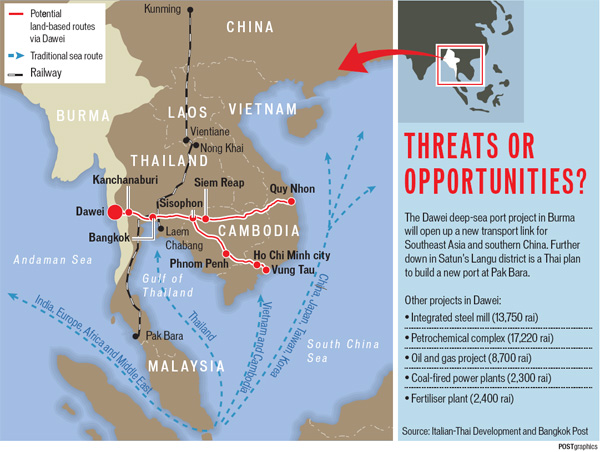
SPECIAL REPORT: Thai delegation visits Dawei today in an effort to strengthen confidence in an ambitious scheme

  • Published: 7/01/2012 at 12:00 AM
  • Newspaper section: News

  • There seems little doubt about the potential of the ambitious Dawei project, but attracting business partners to bring it to fruition might not be easy amid doubts about the political outlook in Burma.
    The trip by the Thai ministers of foreign affairs, finance, industry, energy and transport to Dawei today is seen as an attempt to bolster confidence among prospective investors for the mega-project and to send a message to the international community that Burma is serious about opening up the country.
    The visit was arranged after two requests from Burmese President Thein Sein to Prime Minister Yingluck Shinawatra.
    Italian-Thai Development Plc (ITD) has been granted a 75-year concession for the special economic zone in Dawei that covers 250 square kilometres, 10 times bigger than the Map Ta Phut Industrial Estate in Rayong.
    The deep-sea port of 6,100 rai of land alone is five times the size of Laem Chabang port in Chon Buri.
    Transport Minister Sukumpol Suwanatat reaffirmed Thai support for the port construction and another five projects there as it is a showcase of Thai investment in Burma.
    Dawei is about 300km from the Thai border province of Kanchanaburi. Part of the industrial development plan is to build a land transport link with Thailand and other mainland Southeast Asian countries, making it a key industrial site and port for the region.
    The project is part of the Southern Economic Corridor under the Greater Mekong Subregion initiative.
    But turning the project from a blueprint to a reality may be a challenge, says Chula Sukmanop, an expert on logistics at the Transport Ministry. Investors will take into account political factors in Burma while calculating their business risks and gains.
    "Political stability is one of the conditions for investors," Mr Chula says.
    Burma realised this problem and tried to build foreign investor confidence in the project by issuing the Dawei Special Economic Zone law last year. The law is to assure foreigners that their investments would be guaranteed in case of any political change in Burma, a Thai government source familiar with the project noted.
    ITD chairman Premchai Karnasuta said recently that the company was targeting loan deals of at least US$12.5 billion (387 billion baht) this year to finance key projects in Dawei. These include $3.5 billion for port and road construction, $2 billion for a rail project and $7 billion for coal-fired power plants with a combined capacity of 4,000 megawatts.
    The contractor has been in talks with the Japan Bank for International Cooperation for loans to finance the port and road development, while Chinese lenders are keen to provide funding for the rail project.
    The firm plans to conclude financial agreements for an integrated steel mill, oil and gas facilities, petrochemical complex and fertiliser plant projects as well as a selection of its strategic partners this year.
    ITD also plans to sell 50,000 rai, or 30%, of the total area in Dawei next year. Proceeds will be used to finance the six priority projects.
    Although Dawei is intended to serve industries in the zone, it can be developed into a key port to avoid sea lane traffic congestion in the Malacca Straits. It can shorten the travelling time of cargo ships from Southeast and East Asia to markets in Europe and the Middle East. The land transport will link Dawei with other ports in Thailand and Vietnam.
    "Many countries such as Japan and China are paying attention to this route due to its potential and it could be a production base for them. The Southern Economic Corridor is important in terms of economic benefits," the source said.
    Foreign Minister Surapong Tovichakchaikul said the port will bolster the connections of members of the Association of Southeast Asian Nations and its partners China and Japan.
    Thailand is also considering building a deep-sea port at Pak Bara in Langu district of Satun for exports from Thailand and China, with the same goal of bypassing the Malacca Straits.
    The Pak Bara project has been on and off since the first study seven years ago due to environmental concerns as it will be built in the Petra National Marine Park.
    ACM Sukumpol and Mr Chula see no threat from the Dawei port to Pak Bara because of their different purposes. The Dawei deep-sea port is built to feed raw materials to other projects there, while Pak Bara will be exclusively developed for imports and exports, they said.
    An advantage of Pak Bara is it will have a land link between the Andaman Sea and the Gulf of Thailand, as well as a rail connection to China, according to the transport minister.
    The Pak Bara project will be considered after the completion of the rail link between Thailand and China via Laos, ACM Sukumpol says.
    But Mr Chula cautioned that the Dawei deep-sea port could emerge as a rival to the Thai port in the next 10 years.
    "The Dawei deep-sea port and the Pak Bara deep-sea port will target different markets but Thailand has to be prepared," he said.
    Tanit Sorat, vice-chairman of the Federation of Thai Industries, said the Dawei port is an ambitious plan. It positions itself as a global port to compete directly with those in Malaysia and Singapore, he said.
    The port could be a western gateway for Thailand, which has no clear policy on a deep-sea port for the western coast.
    "I think Dawei could be an option for Thai investors," Mr Tanit said, citing such upstream industries as oil and gas or steel to be developed there, plus the need to relocate to flood-free areas and away from the planned hike of the minimum daily wage to 300 baht.
    "By the time Dawei is in operation, industries in Thailand will be much more advanced than today," he said. "Thailand will move away from heavy industries such as petrochemicals and leave them to neighbouring countries."