Wednesday, February 8, 2012

PRIVATISATION TO ACCELERATE AIRPORT EXPANSION

Brazil gets a handsome $14b for three airports


Brazil took a major step toward modernising its airports on Monday by selling multi-year concessions worth US$14 billion to operate three of the busiest hubs, and secured a huge premium from local and international companies.

As with other areas of Brazil's stretched physical infrastructure, the country's airports are groaning under the rapid expansion of the domestic market, reported Dow Jones Newswires.

Brisk economic growth and record low unemployment have created millions of entrants into Brazil's middle class. That in turn has spurred air traffic growth of double-digit rates, with demand jumping 16 percent in 2011 to about 180 million passengers.

The government is also scrambling to be ready to receive visitors to the 2014 World Cup and the 2016 Olympic Games. Privatisation is seen as a mechanism for accelerating the expansion plans, as red tape tends to tie the hands of the government-run airports operator, Infraero president Gustavo do Vale said.

Contracts to upgrade and operate airports in the cities of Sao Paulo, Campinas and Brasilia were sold for a total of $14 billion, more than four times the government's initial asking price, a reflection of strong demand for the opportunity to manage the infrastructure of one of the world's fastest growing airline markets.

"The result is a positive sign that this country is a place where investments are safe and profitable," said Wagner Bittencourt, Brazil's Civil Aviation Secretary, which oversaw the auction process.

Brazil opted last year to privatise several airports, and sold a small airport in Brazil's northeast. Monday's auction marks a major step forward.

The prize asset, the Guarulhos airport in Sao Paulo, was taken by Investimentos e Participacoes em Infraestrutura SA or Invepar, a holding company made up of construction companies and some of Brazil's largest pension funds – together with Airports Co South Africa. The partners bid $9.41 billion, considerably higher than the next bid of $7.5 billion, made by EcoRodovias Infraestrutura e Logistica and Germany's Fraport.

"We are very confident about the bid we made," said Gustavo Rocha, chief executive of Invepar. "The bid was made based on months of studies and modeling. We didn't make the bid just to scare off other bidders."

Guarulhos was considered to be the most attractive of the batch because it already has a huge flow of customers, and so guaranteed revenues. The airport in Brasilia is smaller, but still has a significant customer base; its concession was picked up by Brazil's Engevix construction firm and Argentina's Corporacion America, with a bid of $2.62 billion, seven times the minimum.

Transportation company Triunfo Participacoes won rights to operate the Viracopos airport in Campinas, which is slated to become Brazil's biggest airport, but which will require the mosinvestment, at $5.06 billion. Triunfo partnered with construction company UTC Participacoes and France's Egis Airport Operation to bid $2.21 billion, more than double the starting price of $871.69 million.

Despite bringing in private-sector operators, the government is still expected to pay a dominant role in the funding for the airports, via the national development bank, or BNDES, which has agreed to lend about 80 percent of capital needs – excluding the amount paid for the licence – at heavily subsidised interest rates.

"During the first phase we will make use of BNDES, as it will be enough to start construction work," Triunfo's Bottarelli said.
"We may use infrastructure bonds. We know what rates BNDES charges, let's see what the market asks for."

Infrastructure bonds are a new class of debt for which the government is in the process of creating new incentives including tax cuts.

Meanwhile, the success of Monday's auction is likely to encourage more concessions later this year. Secretary Bittencourt told reporters the government is planning concessions for airports in Rio de Janeiro and Belo Horizonte.

Sunday, February 5, 2012

MORE ON RAPID TRANSIT


Saturday February 4, 2012

More than 90 projects worth billions to be farmed out by April

By RISEN JAYASEELAN and SHARIDAN M. ALI
starbiz@thestar.com.my

After some dithering, the construction of the My Rapid Transit (MRT) project is moving into higher gear. The two major contracts awarded byMRT Co last week that totalled some RMl.6bil is proof that things are moving.

What's to come is more telling. By April, MRT Co, the overseer and project owner of the country's largest ever infrastructure project, would have awarded a total of around 90 or so projects. The figure of these contracts run into billions and would clearly be a major boost to the construction and related sectors.
The multiplier effect on the economy will soon be felt.
“We have been waiting for this, as these projects have already been earmarked by the Government before. The industry and the country need these projects to spur economic growth, in light of the gloomy global scene. The multiplier effects are well spelt out,” says Master Builders Association Malaysia (MBAM) president Kwan Foh-Kwai.
While research houses have yet to make an outright bullish call on the construction and related sectors, there are hints that a re-rating is in the offing. Among the larger contracts that are being dished out are for elevated civil works that entail the building of viaduct guideways and other associated works. There are eight of these packages, each averaging RM500mil, according to MRT Co.
However, the two that have already been awarded recently to IJM Corp Bhd and Ahmad Zaki Resources Bhd were for RM974mil and RM764mil respectively, indicating that the RM500mil figure could be on the low side.
There are also contracts for stations and depots. And the single biggest one will be for tunnelling works for the 9.5km underground portion of the Sungai Buloh-Kajang MRT line.
The bill for this is estimated at 40% of the total project cost, which is estimated at RM30bil. The first line stretches 51km.
“The positive news from MRT Co reinforces our positive view on the construction sector as we expect a lot of sizeable projects to be awarded this year,” wrote MIDF Research in a recent note.
OSK Research said that if it did turn positive on the Malaysia market, construction would be one of the sectors it would be bullish about.
Its research head Chris Eng says: “If global markets hold up, the improved risk-taking sentiment will provide a boost to construction stocks, given that the MRT awards will happen this year.”
But are the contracts being farmed out too hurriedly? And what assurance is there that the right parties are winning the awards? These are valid concerns, considering that Malaysia has a questionable track record when it comes to the building of large infrastructure projects in terms of contractors' ability to deliver the goods in time and within budget. In the past, a massive amount of money had been spent by the Government in bailing out the two light rapid transit (LRT) operators and the monorail project.
Federation of Malaysian Consumers Associations secretary-general Muhammad Sha'ani Abdullah says:“Caution should be taken to ensure that the best and deserving companies are awarded the deals. We don't want situations where companies chosen later fail to carry out the projects within budget and time. And these companies then end up getting bailed out by the Government, as had happened in other infrastructure projects in this country.”
But MRT Co CEO Datuk Azhar Abdul Hamid explains that the plan to get these contracts awarded by April is to ensure that the MRT (since renamed Klang Valley MY Rapid Transit or KVMRT) isn't delayed.
“We are already about six months behind schedule and also want to make sure we can deliver the project ahead of the expected completion time in July 2017. There is nothing wrong to speed things up as we do not rely on one company to do the work and that's why we are spreading it out. The most important thing is coordination and supervision,” he says.
Rigorous selection process
Azhar explains that a rigorous process is involved in deciding which companies are awarded with the contracts. In fact, the selection process dates back to even before Azhar, the former head of Sime Darby's plantation division, was made chief executive of MRT Co last August.
Syarikat Prasarana Negara Bhd (Prasarana) which was first tasked with managing the KVMRT project, had earlier called for parties to express their interest in participating in the works for the KVMRT. That was back in 2010 and by September 2011, Prasarana had decided on the “pre-qualification” list for all the different packages involved in building the KVMRT.
According to Azhar, the bids which are then submitted by the pre-qualified contractors are first evaluated by a working committee chaired by both MRT Co and the Project Delivery Partner (PDP) to gauge applicants' technical and financial capabilities. One unique feature of the KVMRT project is the presence of the PDP. In late 2010, a Gamuda-MMC consortium, who had first pitched a plan of the MRT to the Government in the early part of that year, had been appointed as PDP consultants for the MRT project.
The PDP bear certain management risks in this project and are therefore key stakeholders in the KVMRT. Hence it has a say in the decision-making process of contract awards.
From there, the applications go on to a one-stop technical committee chaired by Azhar.
“Finally, we will present the outcome of these evaluations to the one-stop procurement committee to be chaired by three different persons depending on the contract value.”
The chairpersons include Finance Ministry secretary-general for contracts up to RM50mil; the Second Finance Minister (up to RM300mil) and the Prime Minister for contracts worth more than RM300mil.
Checks and balance
Additionally, the KVMRT project has two very notable checks and balances in place to minimise the Government having to provide additional funding in the event contractors can't deliver. First is the role of the PDP. Explains Azhar: “Under the PDP environment there's a step-in clause where if the contractors fail to undertake and continue doing the jobs, the PDP is obliged to come in and get the job done.”
Azhar adds that in cases where there are cost overruns, it is only to be expected that the PDP will also be penalised for that. “In the case of variation orders, we will only look at very exceptional cases,” Azhar says.
Aside from the PDP, there's also the role of the independent consulting engineer or ICE. It has been reported that Prasarana had already issued a letter of intent to engineering firm HSS Integrated Sdn Bhd in a JV with SNC Lavalin (of Canada) to take on the role of ICE. HSSI was previously involved in the design, construction and supervision of the KL International Airport, the Light Rail Transit System 2, the North-South Expressway, Maju Expressway and the Express Rail Link.
Azhar says the role of the ICE is crucial as it will monitor the progress of the project and its input is needed before contractors are paid. It is also tasked with safety aspects of the project.
Still on the issue of the PDP, recall that the appointment of Gamuda-MMC as the PDP for the KVMRT project had caused some controversy, considering that they are also bidding for the tunnelling portion, which is single biggest contract in building the MRT.
Azhar explains that it is Gamuda and MMC who has first come up with the MRT proposal to the Government and they have from the start indicated their keenness to be involved in the tunnelling portion of the project.
“To ensure proper due diligence and that the Government is getting the right pricing for the tunnelling portion, that's the basis of having the Swiss Challenge method for picking the tunnelling contractor,” Azhar says.
To date, five groups of companies, including the Gamuda-MMC JV, have been shortlisted for the tunnelling job. If Gamuda-MMC wins the tunnelling job, it would step out of the PDP role relating to that part of the project. Under the Swiss Challenge system, MMC-Gamuda will have the first right of refusal to do the job at the lowest bid plus a small 2.5% to 7.5% margin. Curiously, this has not stopped other parties from making a bid.
“Take note that the other bidders for the tunneling job are made up of two Chinese, one South Korean and one Japanese company. Aren't they also able to have advantages of economies of scale and possibly government funding on their part?” Azhar notes.
Crucial issue of funding
As the KVMRT goes into high speed, many are still questioning if the country can really afford a project as ambitious as this. It is estimated that the first line of the KVMRT would cost around RM30bil. But he says: “The Government will finance the entire line 1 (Sungai Buloh-Kajang) via bond issuances. That will be done very soon. In the mean time, if we need money, we can used short-term financing from financial institutions which can then be converted into bonds later on. We expect good response for the bonds as there is a lot of liquidity in the market as well as investors are looking at Asia now as the situation the West is not quite healthy.”
Azhar says that it will be Dana Infra that will be raising the bonds.
It has been reported that a special unit of the Finance Ministry calledDana Infra Nasional Bhd (Dana Infra) has been set up to issue bonds to raise the financing for the MRT building cost. Checks with Government sources reveal that Dana Infra is headed by Fazlur Rahman Ebrahim, who is the current managing director of Prokhas Sdn Bhd, itself a unit of MoF that was set up in 2006 to manage the residual assets of Danaharta.
Fazlur has yet to respond to queries from StarBizWeek on the planned bond issuance. Sources, however, have indicated that these bonds would be fully government-backed.
The Government has stated in the past that the rationale for the KVMRT being government-funded is on the basis of the multiplier effects it would have on economic growth in the country and the competitive advantage that the Klang Valley would have once the MRT was up and running
It had also been reported that while the MRT was not going to be profitable, there would be a strong focus to reduce its cost and this was where a “rail plus property” plan had been cited before, where some level of real estate development would be emarked on to recoup some of the losses from the MRT. Another non-fair revenues would be sought such as from advertising.
StarBizWeek had previously quoted economist Dr Yeah Kim Leng ofRAM Holdings, who opined that assuming RM30bil is raised by the Government via bonds to the fund the MRT, it will raise the Government debt-to-GDP ratio by 3.9 percentage points to 57% based on the 2010 gross domestic product (GDP) figure.
He said when compared with the debt situation of many advanced economies where the debt levels are either close to or above 100% of GDP, the Government does have the borrowing capacity. He had also said that the bond issuance of RM30bil would raise the fiscal deficit by an estimated 0.2% of GDP which “may necessitate either a cut-back in spending on other areas or raising revenue through means such as asset sales or tax increases, in order to achieve the fiscal deficit target of less than 3% of GDP by 2015,” he reportedly said.
On a positive note, Yeah had added that the MRT project would “boost the economy by adding jobs and crowding-in investment which would have the desired effect of enlarging the GDP, thereby contributing to either stabilising or lowering the debt-to-GDP ratio”.
Those following the KVMRT saga would also be aware of the problems Azhar and his team faced when securing the allignment in some parts of the city centre. There were quarters who opposed the development of the KVMRT. Azhar is confident that the problems would eventually be ironed out. His message has been consistent: that MRT Co isn't interested in taking land in places like Chinatown, except for the station. “We just need the time for them to vacate the area with compensation for six months for us to do the tunnelling works underground.”
But Azhar goes on to say:”Some people just refuse to understand.”
The KVMRT though, is going ahead and Azhar is winning the battle with the majority of land owners having inked agreements to facilitate the MRT allignment. “A lot of efforts are being made on our part to do this correctly. We will get there,” he ethuses and is hopeful that the July 2017 target for the first line of the KVMRT would be achieved.

Sunday, January 22, 2012

PENANG PORT


Monday January 23, 2012

Penang Port sees slow 2012

By DAVID TAN
davidtan@thestar.com.my


GEORGE TOWN: Penang Port Sdn Bhd is targeting for the container cargo handled at its North Butterworth Container Terminal (NBCT) to hit 1.278 million 20-ft equivalent units (TEUs) this year, an increase of about 7.4% from last year.
Penang Port chief operating officer Obaid Mansor told StarBiz that 2012 was expected to be a slower year due to the bleak global economic outlook.
“We expect a slower growth of 7.4% compared with 8.4% in 2011. Although the China market is slowing down, we can still rely on intra-Asian trade among large economies such as Indonesia and India for growth.
“Thus, for the first quarter 2012, we expect the volume of container cargo handled at NBCT to grow about 4% over last year’s corresponding period, which handled 278,161 TEUs,” he said.
In 2009, at the peak of the US subprime crisis, the volume of container cargo handled at NBCT grew about 3% over 2008, according to Obaid.
“Because growth this year is expected to be slower, we will maintain our workforce level at 1,600,” he added.
About 75% of the cargo handled at NBCT is full container load, which is expected to generate 70% of Penang Port’s revenue this year.
Obaid said the export and import of special glasses for solar panel manufacturing was on the rise, as more international solar power manufacturing companies were moving to Malaysia.
“We are also seeing a growth in rubber-based products being exported and imported out of NBCT,” he said.
Obaid said eight units of rail-mounted gantry crane at the NBCT were now being installed for operations at the end of March.
“These cranes will increase the speed of transferring container cargo to NBCT and to the vessels,” he added.
On the implementation of new port tariffs, Obaid said the review was now being studied by Penang Port Commission.

Friday, January 20, 2012

AIRCRAFT PRODUCTION

Airbus flies ahead of Boeing in 2011

Airbus retained its position as the world's leading builder and seller of commercial jets last year, but acknowledged that 2012 will be a different story as the duopoly in the global market that the European plane maker shares with US rival Boeing Co becomes more balanced, reported the Wall Street Journal.

Thanks to a steady increase in its production rates, Airbus delivered a record 534 aircraft of more than 100 seats last year, a 4.7 percent rise from 510 in 2010 and 12 percent more than the 477 planes that Boeing produced, Airbus chief executive Tom Enders told a press conference.

The wholly-owned division of European Aeronautic Defence & Space booked 1,608 gross orders last year, marking a new industry record for annual orders, and putting in the shade Boeing's 921 orders. These numbers translate into a global market share of 64 percent for Airbus, compared with 36 percent for Boeing. This was mirrored by the result for orders excluding cancellations, with Airbus racking up 1,419 net orders compared to Boeing's 805.

In revenue terms, Airbus also came first. Its gross orders were worth US$168.8 billion, while net orders came in at $140.5 billion.

EADS "is a growth story and a cash machine" thanks to the surge in commercial-aircraft orders and higher prices, the aero-defense group's chief executive Louis Gallois said.

EADS revenue in 2011 was "nicely" above the 2010 level of US57.89 billion thanks to increased pricing and the surge in order intake at Airbus, Gallois said. EADS will see a "significant" rise in profitability in 2012, he added, helped by reduced losses from the Airbus A380 programme and stepped-up production.

EADS stock has risen 24 percent in the past year, the best performer among component stocks of the CAC-40 benchmark index.

However, the surge in orders as airlines rushed to buy a new fuel-efficient version of the A320 medium-haul jet will subside in 2012, Airbus chief operating officer, customers, John Leahy said.

Leahy said that for now there's no problem with aircraft financing even though some providers, notably French ones, have pulled out of the business. "It is tighter in 2012 than in 2011, but we think we'll be able to get through," he said.

More than half of this year's deliveries are assured of financing, he said, some with debt financing, some with airlines' own cash and some under sale and lease back schemes.

"The situation with French banks is that they are having some difficulty raising US dollars," he said, "but other banks around the world don't have that same problem."

Even as demand slackens this year, Airbus and Boeing will continue to dominate the market for large jetliners, Leahy said.
"Our goal is to remain in a stable duopoly with a market share of between 60 percent and 40 percent and I predict that in 2012 we will be down around 50 percent, probably even lower," he said.
Boeing is expected to keep pulling in orders for the 737 MAX, a re-engined version of the jet that's a workhorse for many low-cost airlines. Leahy said order intake this year is likely to be between 600 and 650 new orders, a steep drop from 2011.

With a year-end order backlog of 4,437 aircraft compared to Boeing's 3,771, Airbus reckons that it's fairly well shielded from any potential downturn in global air traffic that might accompany an economic slowdown and encourage airlines to hold off expanding or renewing their fleets. The current backlog represents more than eight years of production at current rates, but Airbus is stepping up output to reduce the long lead times between orders and deliveries. At the same time, Airbus has a policy of over-booking its delivery slots so that it doesn't end up with unsold aircraft on the tarmac.

Airbus said it's planning to increase deliveries in 2012 to around 570, mainly due to rising production of the fast-selling A320 family of medium-haul, single-aisle jets. Just over a year ago, Airbus decided to launch a re-engined version of the A320 that the company claims will offer 15 percent fuel savings compared to the current version. The new catalogue addition, called the A320neo, resulted in 1,226 firm orders last year, or three-quarters of total order intake.

Airbus delivered 26 of its A380 super jumbos last year and took in 29 orders. Leahy said 30 A380s should be delivered this year, and he's aiming to match that figure with fresh orders. He said customers are asking Airbus to work on a stretched version of the double-decker A380, which can already carry up to 850 passengers. He said a longer plane could add an extra 100 to 150 seats. Airbus is currently making A320s at a rate of 38 a month and plans to raise production to 42 a month by the end of this year.

Leahy cast doubt on Boeing's claim that it has over 1,000 firm orders and commitments for the 737 MAX, saying most of the commitments Boeing refers to seem to be non-binding "letters of possible interest" signed by airlines that say they like what they see and might buy it at some point.

"They haven't given prices to these people. They haven't given hard delivery slots or performance data—any money that was put down is totally refundable," Leahy told a group of reporters.

While Airbus took 70 percent of the market segment of smaller 100 to 200-seat aircraft, Boeing took three-quarters of the global market for wide-bodied jets with between 275 and 375 seats, thanks to its popular 777 jetliner and new 787-9 plane.

Airbus' rival in this category, the new A350-900, is due to enter into service in 2014, with a stretched version set to come to market by 2017.

Sunday, January 8, 2012

MALAYSIA'S LOGISTICS SECTOR TO GROW IN 2012


KUALA LUMPUR: The Malaysian logistics industry is expected to grow by 10.3% to RM129.93 billion in 2012 against an estimated RM117.8bil last year, on strong government support for logistics-related development and growth fuelled by foreign investments.
Malaysia's strategic location and focus on improving supply chain efficiency were also key growth drivers, said Frost & Sullivan vice-president, transportation & logistics practice, Asia-Pacific and country head for Malaysia, Gopal R.
“Growth of the country's external trade signifies growth of the transportation and logistics industry especially for import and export forwarding, air freight and ocean freight-related businesses,” said Gopal, adding that external trade for Malaysia was expected to increase 5.9% year-on-year to RM1.32 trillion in 2012.
Foreign direct investments surged to RM21.3bil in the first half of 2011 compared with RM12.1bil in the corresponding period in 2010, reflecting the growing confidence in the wake of Government initiatives to stimulate economic growth.
“The introduction of several initiatives such as the Government Transformation Programme and the Economic Transformation Programme provided a conducive business environment for the logistics market,” he said.
Malaysia's major trading partners are Asian countries which are expected to experience stable economic growth.
“However, the share of trade with Japan and Thailand is expected to shrink due to supply chain disruptions and production slowdown following disasters in the respective countries,” Gopal said.
The country's key trading commodities are electrical and electronic products, chemicals, palm oil, machinery, appliances and parts.
The Malaysian logistics industry is forecast to grow at a compounded annual growth rate (CAGR) of 11.6% to reach RM203.71bil in 2016. In terms of volumes, Gopal forecast Malaysia's total cargo volumes to increase 10.1% to 545.13mil tonnes in 2012 compared with 495.29 million tonnes in 2011.
“Sea-freight is the most favoured mode of transport for cargoes in Malaysia, (comprising) more than 90% of total freight traffic in 2011,” he said. Gopal said total cargo volume by sea was expected to grow 10.1% to 538 million tonnes in 2012.
Cargo volume by rail is expected to increase to 6.2 million tonnes in 2012 compared with 5.9 million tonnes in 2011. Gopal predicted cargo volume by air to grow 3.9% to 925,000 tonnes this year buoyed by steady growth in the economy and external trade.

Friday, January 6, 2012

BURMESE PORTS OPENING UP


Burma keen to prove it's open to foreign investors

SPECIAL REPORT: Thai delegation visits Dawei today in an effort to strengthen confidence in an ambitious scheme

  • Published: 7/01/2012 at 12:00 AM
  • Newspaper section: News

  • There seems little doubt about the potential of the ambitious Dawei project, but attracting business partners to bring it to fruition might not be easy amid doubts about the political outlook in Burma.
    The trip by the Thai ministers of foreign affairs, finance, industry, energy and transport to Dawei today is seen as an attempt to bolster confidence among prospective investors for the mega-project and to send a message to the international community that Burma is serious about opening up the country.
    The visit was arranged after two requests from Burmese President Thein Sein to Prime Minister Yingluck Shinawatra.
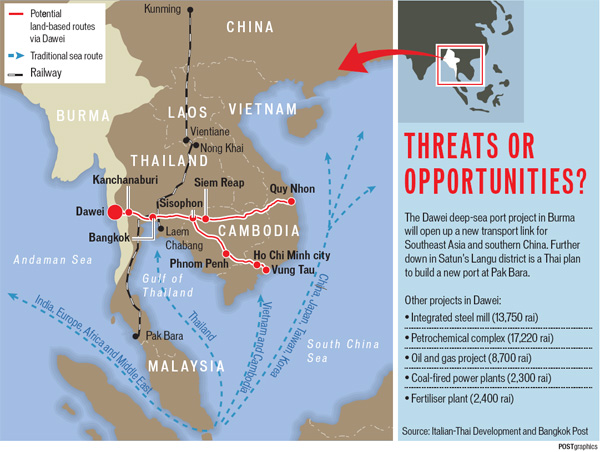
    Italian-Thai Development Plc (ITD) has been granted a 75-year concession for the special economic zone in Dawei that covers 250 square kilometres, 10 times bigger than the Map Ta Phut Industrial Estate in Rayong.
    The deep-sea port of 6,100 rai of land alone is five times the size of Laem Chabang port in Chon Buri.
    Transport Minister Sukumpol Suwanatat reaffirmed Thai support for the port construction and another five projects there as it is a showcase of Thai investment in Burma.
    Dawei is about 300km from the Thai border province of Kanchanaburi. Part of the industrial development plan is to build a land transport link with Thailand and other mainland Southeast Asian countries, making it a key industrial site and port for the region.
    The project is part of the Southern Economic Corridor under the Greater Mekong Subregion initiative.
    But turning the project from a blueprint to a reality may be a challenge, says Chula Sukmanop, an expert on logistics at the Transport Ministry. Investors will take into account political factors in Burma while calculating their business risks and gains.
    "Political stability is one of the conditions for investors," Mr Chula says.
    Burma realised this problem and tried to build foreign investor confidence in the project by issuing the Dawei Special Economic Zone law last year. The law is to assure foreigners that their investments would be guaranteed in case of any political change in Burma, a Thai government source familiar with the project noted.
    ITD chairman Premchai Karnasuta said recently that the company was targeting loan deals of at least US$12.5 billion (387 billion baht) this year to finance key projects in Dawei. These include $3.5 billion for port and road construction, $2 billion for a rail project and $7 billion for coal-fired power plants with a combined capacity of 4,000 megawatts.
    The contractor has been in talks with the Japan Bank for International Cooperation for loans to finance the port and road development, while Chinese lenders are keen to provide funding for the rail project.
    The firm plans to conclude financial agreements for an integrated steel mill, oil and gas facilities, petrochemical complex and fertiliser plant projects as well as a selection of its strategic partners this year.
    ITD also plans to sell 50,000 rai, or 30%, of the total area in Dawei next year. Proceeds will be used to finance the six priority projects.
    Although Dawei is intended to serve industries in the zone, it can be developed into a key port to avoid sea lane traffic congestion in the Malacca Straits. It can shorten the travelling time of cargo ships from Southeast and East Asia to markets in Europe and the Middle East. The land transport will link Dawei with other ports in Thailand and Vietnam.
    "Many countries such as Japan and China are paying attention to this route due to its potential and it could be a production base for them. The Southern Economic Corridor is important in terms of economic benefits," the source said.
    Foreign Minister Surapong Tovichakchaikul said the port will bolster the connections of members of the Association of Southeast Asian Nations and its partners China and Japan.
    Thailand is also considering building a deep-sea port at Pak Bara in Langu district of Satun for exports from Thailand and China, with the same goal of bypassing the Malacca Straits.
    The Pak Bara project has been on and off since the first study seven years ago due to environmental concerns as it will be built in the Petra National Marine Park.
    ACM Sukumpol and Mr Chula see no threat from the Dawei port to Pak Bara because of their different purposes. The Dawei deep-sea port is built to feed raw materials to other projects there, while Pak Bara will be exclusively developed for imports and exports, they said.
    An advantage of Pak Bara is it will have a land link between the Andaman Sea and the Gulf of Thailand, as well as a rail connection to China, according to the transport minister.
    The Pak Bara project will be considered after the completion of the rail link between Thailand and China via Laos, ACM Sukumpol says.
    But Mr Chula cautioned that the Dawei deep-sea port could emerge as a rival to the Thai port in the next 10 years.
    "The Dawei deep-sea port and the Pak Bara deep-sea port will target different markets but Thailand has to be prepared," he said.
    Tanit Sorat, vice-chairman of the Federation of Thai Industries, said the Dawei port is an ambitious plan. It positions itself as a global port to compete directly with those in Malaysia and Singapore, he said.
    The port could be a western gateway for Thailand, which has no clear policy on a deep-sea port for the western coast.
    "I think Dawei could be an option for Thai investors," Mr Tanit said, citing such upstream industries as oil and gas or steel to be developed there, plus the need to relocate to flood-free areas and away from the planned hike of the minimum daily wage to 300 baht.
    "By the time Dawei is in operation, industries in Thailand will be much more advanced than today," he said. "Thailand will move away from heavy industries such as petrochemicals and leave them to neighbouring countries."


Monday, January 2, 2012

DOMESTIC MARKET AS THE LAUNCHING PAD


Saturday December 31, 2011

Ability to win out there

BY DATUK SERI IDRIS JALA

Local companies must use the domestic market as a launching pad and look beyond our shores. 

WHILE on vacation in Perth some months ago, I went fishing with my nephew. It was a quiet, beautiful beach, but we had no luck in catching fish! Then, my nephew saw an Australian fishing round the bend, and he was reeling in fish after fish. My nephew took his rod and walked over to him. He stood next to the guy, put in the bait and cast his line into the water. In just minutes, his line was entangled with the Aussie's.

Naturally, my nephew was embarrassed and totally apologetic. As he apologised, the gentleman looked him in the eye and said, “It's a big beach, mate!”
The point is exactly that. The world is a very big beach. It is a huge global market out there. So, when we start quarrelling among ourselves about the small domestic market, we have a problem. We are completely missing the point.
Malaysian companies must use the domestic market as a launching pad and then look beyond our shores. The local market is only the starting point. Our future lies in our ability to win out there. That cannot happen until and unless competitiveness truly exists among Malaysian entrepreneurs.
To my mind, this is the new dawn which we must work towards. Malaysia can do it but we must not get bogged down in arguing about the domestic market.
Building strong brands
We must look forward to a time when Malaysian companies can say that we have produced a particular mobile phone or that we own 60% market share for LED televisions. Today, these products are made in South Korea. We don't have strong global brands. Why? Could it be because Malaysians are not “kiasu” enough? Or maybe, Malaysians are not hungry enough.
Look around. There are many stories of billion-dollar companies that began as small businesses. Look at Samsung and LG. Both the South Korean corporations started small in their local market. Today, Samsung is one of the biggest global brands in mobile devices, and LG is a household name.
With the Economic Transformation Programme (ETP), we have set out to create a competitive environment. We announced six reform initiatives in July this year, and are working towards implementing the lab recommendations.
In the recent Budget, the Prime Minister announced the liberalisation of 17 services sub-sectors in phases in 2012. We are also open to foreign equity participation of up to 100% in selected sub-sectors. In addition, come January 2012, the Competition Law will be implemented.
These structural reform initiatives complement our focus areas the 12 National Key Economic Areas. We need both focus and competitiveness to transform Malaysia into a competitive high-income nation.
Successful countries that have bred global brands have gone through this path. How did South Korea transform itself? There is no clarity and it probably happened over a period of time. But the pattern was clear it was very focused.
Take Singapore. It wants to be a logistics and trading hub. I remember Lee Kuan Yew giving a speech at the invitation of the International Air Transport Association. He was asked about Singapore Airlines. He said he did not care whether or not Singapore Airlines succeeded. He cared more that Changi succeeded.
If Singapore Airlines cannot be competitive, Singapore will have to open its doors to other airlines. To Lee, it came down to the fact that Singapore Airlines must be competitive; the goal was to make Singapore a logistics hub, not whether Singapore Airlines succeeded.
Be focused, competitive
So, we must wake up to this and if we look at other countries, the pattern is clear: It is all about being focused and competitive.
What we are seeing now is a new dawn for our country and Malaysian entrepreneurs. As a country, we are more focused and becoming more competitive. We are attracting more foreign investments. From January to September this year, our foreign direct investments rose 42% to RM26.4bil from RM18.6bil in the previous corresponding period.
Our economic rankings globally have also improved. In the World Economic Forum Global Competitive Report, 2011-2012, our ranking improved to 21st from 26th among 183 economies. Malaysia was the sixth most competitive country among Asia-Pacific economies and second in Asean.
This is a good start for our 10-year ETP roadmap. The time is right for Malaysian entrepreneurs to leverage the competitive environment, grow their businesses locally and around the globe. Now is the time to move beyond the Malaysian shores.
As the Australian on the beach aptly put it, “The beach is very big, mate!” I say to my fellow Malaysians: To let us get our Malaysian products out into the global marketplace, we need to befocused and competitive. We can all be winners.
 Senator Datuk Seri Idris Jala is Minister in the Prime Minister's Department and CEO of the Performance Management & Delivery Unit (Pemandu).