Sunday, January 22, 2012

PENANG PORT


Monday January 23, 2012

Penang Port sees slow 2012

By DAVID TAN
davidtan@thestar.com.my


GEORGE TOWN: Penang Port Sdn Bhd is targeting for the container cargo handled at its North Butterworth Container Terminal (NBCT) to hit 1.278 million 20-ft equivalent units (TEUs) this year, an increase of about 7.4% from last year.
Penang Port chief operating officer Obaid Mansor told StarBiz that 2012 was expected to be a slower year due to the bleak global economic outlook.
“We expect a slower growth of 7.4% compared with 8.4% in 2011. Although the China market is slowing down, we can still rely on intra-Asian trade among large economies such as Indonesia and India for growth.
“Thus, for the first quarter 2012, we expect the volume of container cargo handled at NBCT to grow about 4% over last year’s corresponding period, which handled 278,161 TEUs,” he said.
In 2009, at the peak of the US subprime crisis, the volume of container cargo handled at NBCT grew about 3% over 2008, according to Obaid.
“Because growth this year is expected to be slower, we will maintain our workforce level at 1,600,” he added.
About 75% of the cargo handled at NBCT is full container load, which is expected to generate 70% of Penang Port’s revenue this year.
Obaid said the export and import of special glasses for solar panel manufacturing was on the rise, as more international solar power manufacturing companies were moving to Malaysia.
“We are also seeing a growth in rubber-based products being exported and imported out of NBCT,” he said.
Obaid said eight units of rail-mounted gantry crane at the NBCT were now being installed for operations at the end of March.
“These cranes will increase the speed of transferring container cargo to NBCT and to the vessels,” he added.
On the implementation of new port tariffs, Obaid said the review was now being studied by Penang Port Commission.

Friday, January 20, 2012

AIRCRAFT PRODUCTION

Airbus flies ahead of Boeing in 2011

Airbus retained its position as the world's leading builder and seller of commercial jets last year, but acknowledged that 2012 will be a different story as the duopoly in the global market that the European plane maker shares with US rival Boeing Co becomes more balanced, reported the Wall Street Journal.

Thanks to a steady increase in its production rates, Airbus delivered a record 534 aircraft of more than 100 seats last year, a 4.7 percent rise from 510 in 2010 and 12 percent more than the 477 planes that Boeing produced, Airbus chief executive Tom Enders told a press conference.

The wholly-owned division of European Aeronautic Defence & Space booked 1,608 gross orders last year, marking a new industry record for annual orders, and putting in the shade Boeing's 921 orders. These numbers translate into a global market share of 64 percent for Airbus, compared with 36 percent for Boeing. This was mirrored by the result for orders excluding cancellations, with Airbus racking up 1,419 net orders compared to Boeing's 805.

In revenue terms, Airbus also came first. Its gross orders were worth US$168.8 billion, while net orders came in at $140.5 billion.

EADS "is a growth story and a cash machine" thanks to the surge in commercial-aircraft orders and higher prices, the aero-defense group's chief executive Louis Gallois said.

EADS revenue in 2011 was "nicely" above the 2010 level of US57.89 billion thanks to increased pricing and the surge in order intake at Airbus, Gallois said. EADS will see a "significant" rise in profitability in 2012, he added, helped by reduced losses from the Airbus A380 programme and stepped-up production.

EADS stock has risen 24 percent in the past year, the best performer among component stocks of the CAC-40 benchmark index.

However, the surge in orders as airlines rushed to buy a new fuel-efficient version of the A320 medium-haul jet will subside in 2012, Airbus chief operating officer, customers, John Leahy said.

Leahy said that for now there's no problem with aircraft financing even though some providers, notably French ones, have pulled out of the business. "It is tighter in 2012 than in 2011, but we think we'll be able to get through," he said.

More than half of this year's deliveries are assured of financing, he said, some with debt financing, some with airlines' own cash and some under sale and lease back schemes.

"The situation with French banks is that they are having some difficulty raising US dollars," he said, "but other banks around the world don't have that same problem."

Even as demand slackens this year, Airbus and Boeing will continue to dominate the market for large jetliners, Leahy said.
"Our goal is to remain in a stable duopoly with a market share of between 60 percent and 40 percent and I predict that in 2012 we will be down around 50 percent, probably even lower," he said.
Boeing is expected to keep pulling in orders for the 737 MAX, a re-engined version of the jet that's a workhorse for many low-cost airlines. Leahy said order intake this year is likely to be between 600 and 650 new orders, a steep drop from 2011.

With a year-end order backlog of 4,437 aircraft compared to Boeing's 3,771, Airbus reckons that it's fairly well shielded from any potential downturn in global air traffic that might accompany an economic slowdown and encourage airlines to hold off expanding or renewing their fleets. The current backlog represents more than eight years of production at current rates, but Airbus is stepping up output to reduce the long lead times between orders and deliveries. At the same time, Airbus has a policy of over-booking its delivery slots so that it doesn't end up with unsold aircraft on the tarmac.

Airbus said it's planning to increase deliveries in 2012 to around 570, mainly due to rising production of the fast-selling A320 family of medium-haul, single-aisle jets. Just over a year ago, Airbus decided to launch a re-engined version of the A320 that the company claims will offer 15 percent fuel savings compared to the current version. The new catalogue addition, called the A320neo, resulted in 1,226 firm orders last year, or three-quarters of total order intake.

Airbus delivered 26 of its A380 super jumbos last year and took in 29 orders. Leahy said 30 A380s should be delivered this year, and he's aiming to match that figure with fresh orders. He said customers are asking Airbus to work on a stretched version of the double-decker A380, which can already carry up to 850 passengers. He said a longer plane could add an extra 100 to 150 seats. Airbus is currently making A320s at a rate of 38 a month and plans to raise production to 42 a month by the end of this year.

Leahy cast doubt on Boeing's claim that it has over 1,000 firm orders and commitments for the 737 MAX, saying most of the commitments Boeing refers to seem to be non-binding "letters of possible interest" signed by airlines that say they like what they see and might buy it at some point.

"They haven't given prices to these people. They haven't given hard delivery slots or performance data—any money that was put down is totally refundable," Leahy told a group of reporters.

While Airbus took 70 percent of the market segment of smaller 100 to 200-seat aircraft, Boeing took three-quarters of the global market for wide-bodied jets with between 275 and 375 seats, thanks to its popular 777 jetliner and new 787-9 plane.

Airbus' rival in this category, the new A350-900, is due to enter into service in 2014, with a stretched version set to come to market by 2017.

Sunday, January 8, 2012

MALAYSIA'S LOGISTICS SECTOR TO GROW IN 2012


KUALA LUMPUR: The Malaysian logistics industry is expected to grow by 10.3% to RM129.93 billion in 2012 against an estimated RM117.8bil last year, on strong government support for logistics-related development and growth fuelled by foreign investments.
Malaysia's strategic location and focus on improving supply chain efficiency were also key growth drivers, said Frost & Sullivan vice-president, transportation & logistics practice, Asia-Pacific and country head for Malaysia, Gopal R.
“Growth of the country's external trade signifies growth of the transportation and logistics industry especially for import and export forwarding, air freight and ocean freight-related businesses,” said Gopal, adding that external trade for Malaysia was expected to increase 5.9% year-on-year to RM1.32 trillion in 2012.
Foreign direct investments surged to RM21.3bil in the first half of 2011 compared with RM12.1bil in the corresponding period in 2010, reflecting the growing confidence in the wake of Government initiatives to stimulate economic growth.
“The introduction of several initiatives such as the Government Transformation Programme and the Economic Transformation Programme provided a conducive business environment for the logistics market,” he said.
Malaysia's major trading partners are Asian countries which are expected to experience stable economic growth.
“However, the share of trade with Japan and Thailand is expected to shrink due to supply chain disruptions and production slowdown following disasters in the respective countries,” Gopal said.
The country's key trading commodities are electrical and electronic products, chemicals, palm oil, machinery, appliances and parts.
The Malaysian logistics industry is forecast to grow at a compounded annual growth rate (CAGR) of 11.6% to reach RM203.71bil in 2016. In terms of volumes, Gopal forecast Malaysia's total cargo volumes to increase 10.1% to 545.13mil tonnes in 2012 compared with 495.29 million tonnes in 2011.
“Sea-freight is the most favoured mode of transport for cargoes in Malaysia, (comprising) more than 90% of total freight traffic in 2011,” he said. Gopal said total cargo volume by sea was expected to grow 10.1% to 538 million tonnes in 2012.
Cargo volume by rail is expected to increase to 6.2 million tonnes in 2012 compared with 5.9 million tonnes in 2011. Gopal predicted cargo volume by air to grow 3.9% to 925,000 tonnes this year buoyed by steady growth in the economy and external trade.

Friday, January 6, 2012

BURMESE PORTS OPENING UP


Burma keen to prove it's open to foreign investors

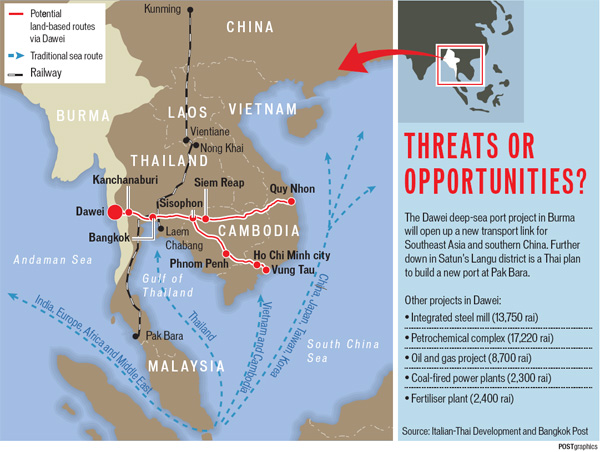
SPECIAL REPORT: Thai delegation visits Dawei today in an effort to strengthen confidence in an ambitious scheme

  • Published: 7/01/2012 at 12:00 AM
  • Newspaper section: News

  • There seems little doubt about the potential of the ambitious Dawei project, but attracting business partners to bring it to fruition might not be easy amid doubts about the political outlook in Burma.
    The trip by the Thai ministers of foreign affairs, finance, industry, energy and transport to Dawei today is seen as an attempt to bolster confidence among prospective investors for the mega-project and to send a message to the international community that Burma is serious about opening up the country.
    The visit was arranged after two requests from Burmese President Thein Sein to Prime Minister Yingluck Shinawatra.
    Italian-Thai Development Plc (ITD) has been granted a 75-year concession for the special economic zone in Dawei that covers 250 square kilometres, 10 times bigger than the Map Ta Phut Industrial Estate in Rayong.
    The deep-sea port of 6,100 rai of land alone is five times the size of Laem Chabang port in Chon Buri.
    Transport Minister Sukumpol Suwanatat reaffirmed Thai support for the port construction and another five projects there as it is a showcase of Thai investment in Burma.
    Dawei is about 300km from the Thai border province of Kanchanaburi. Part of the industrial development plan is to build a land transport link with Thailand and other mainland Southeast Asian countries, making it a key industrial site and port for the region.
    The project is part of the Southern Economic Corridor under the Greater Mekong Subregion initiative.
    But turning the project from a blueprint to a reality may be a challenge, says Chula Sukmanop, an expert on logistics at the Transport Ministry. Investors will take into account political factors in Burma while calculating their business risks and gains.
    "Political stability is one of the conditions for investors," Mr Chula says.
    Burma realised this problem and tried to build foreign investor confidence in the project by issuing the Dawei Special Economic Zone law last year. The law is to assure foreigners that their investments would be guaranteed in case of any political change in Burma, a Thai government source familiar with the project noted.
    ITD chairman Premchai Karnasuta said recently that the company was targeting loan deals of at least US$12.5 billion (387 billion baht) this year to finance key projects in Dawei. These include $3.5 billion for port and road construction, $2 billion for a rail project and $7 billion for coal-fired power plants with a combined capacity of 4,000 megawatts.
    The contractor has been in talks with the Japan Bank for International Cooperation for loans to finance the port and road development, while Chinese lenders are keen to provide funding for the rail project.
    The firm plans to conclude financial agreements for an integrated steel mill, oil and gas facilities, petrochemical complex and fertiliser plant projects as well as a selection of its strategic partners this year.
    ITD also plans to sell 50,000 rai, or 30%, of the total area in Dawei next year. Proceeds will be used to finance the six priority projects.
    Although Dawei is intended to serve industries in the zone, it can be developed into a key port to avoid sea lane traffic congestion in the Malacca Straits. It can shorten the travelling time of cargo ships from Southeast and East Asia to markets in Europe and the Middle East. The land transport will link Dawei with other ports in Thailand and Vietnam.
    "Many countries such as Japan and China are paying attention to this route due to its potential and it could be a production base for them. The Southern Economic Corridor is important in terms of economic benefits," the source said.
    Foreign Minister Surapong Tovichakchaikul said the port will bolster the connections of members of the Association of Southeast Asian Nations and its partners China and Japan.
    Thailand is also considering building a deep-sea port at Pak Bara in Langu district of Satun for exports from Thailand and China, with the same goal of bypassing the Malacca Straits.
    The Pak Bara project has been on and off since the first study seven years ago due to environmental concerns as it will be built in the Petra National Marine Park.
    ACM Sukumpol and Mr Chula see no threat from the Dawei port to Pak Bara because of their different purposes. The Dawei deep-sea port is built to feed raw materials to other projects there, while Pak Bara will be exclusively developed for imports and exports, they said.
    An advantage of Pak Bara is it will have a land link between the Andaman Sea and the Gulf of Thailand, as well as a rail connection to China, according to the transport minister.
    The Pak Bara project will be considered after the completion of the rail link between Thailand and China via Laos, ACM Sukumpol says.
    But Mr Chula cautioned that the Dawei deep-sea port could emerge as a rival to the Thai port in the next 10 years.
    "The Dawei deep-sea port and the Pak Bara deep-sea port will target different markets but Thailand has to be prepared," he said.
    Tanit Sorat, vice-chairman of the Federation of Thai Industries, said the Dawei port is an ambitious plan. It positions itself as a global port to compete directly with those in Malaysia and Singapore, he said.
    The port could be a western gateway for Thailand, which has no clear policy on a deep-sea port for the western coast.
    "I think Dawei could be an option for Thai investors," Mr Tanit said, citing such upstream industries as oil and gas or steel to be developed there, plus the need to relocate to flood-free areas and away from the planned hike of the minimum daily wage to 300 baht.
    "By the time Dawei is in operation, industries in Thailand will be much more advanced than today," he said. "Thailand will move away from heavy industries such as petrochemicals and leave them to neighbouring countries."


Monday, January 2, 2012

DOMESTIC MARKET AS THE LAUNCHING PAD


Saturday December 31, 2011

Ability to win out there

BY DATUK SERI IDRIS JALA

Local companies must use the domestic market as a launching pad and look beyond our shores. 

WHILE on vacation in Perth some months ago, I went fishing with my nephew. It was a quiet, beautiful beach, but we had no luck in catching fish! Then, my nephew saw an Australian fishing round the bend, and he was reeling in fish after fish. My nephew took his rod and walked over to him. He stood next to the guy, put in the bait and cast his line into the water. In just minutes, his line was entangled with the Aussie's.

Naturally, my nephew was embarrassed and totally apologetic. As he apologised, the gentleman looked him in the eye and said, “It's a big beach, mate!”
The point is exactly that. The world is a very big beach. It is a huge global market out there. So, when we start quarrelling among ourselves about the small domestic market, we have a problem. We are completely missing the point.
Malaysian companies must use the domestic market as a launching pad and then look beyond our shores. The local market is only the starting point. Our future lies in our ability to win out there. That cannot happen until and unless competitiveness truly exists among Malaysian entrepreneurs.
To my mind, this is the new dawn which we must work towards. Malaysia can do it but we must not get bogged down in arguing about the domestic market.
Building strong brands
We must look forward to a time when Malaysian companies can say that we have produced a particular mobile phone or that we own 60% market share for LED televisions. Today, these products are made in South Korea. We don't have strong global brands. Why? Could it be because Malaysians are not “kiasu” enough? Or maybe, Malaysians are not hungry enough.
Look around. There are many stories of billion-dollar companies that began as small businesses. Look at Samsung and LG. Both the South Korean corporations started small in their local market. Today, Samsung is one of the biggest global brands in mobile devices, and LG is a household name.
With the Economic Transformation Programme (ETP), we have set out to create a competitive environment. We announced six reform initiatives in July this year, and are working towards implementing the lab recommendations.
In the recent Budget, the Prime Minister announced the liberalisation of 17 services sub-sectors in phases in 2012. We are also open to foreign equity participation of up to 100% in selected sub-sectors. In addition, come January 2012, the Competition Law will be implemented.
These structural reform initiatives complement our focus areas the 12 National Key Economic Areas. We need both focus and competitiveness to transform Malaysia into a competitive high-income nation.
Successful countries that have bred global brands have gone through this path. How did South Korea transform itself? There is no clarity and it probably happened over a period of time. But the pattern was clear it was very focused.
Take Singapore. It wants to be a logistics and trading hub. I remember Lee Kuan Yew giving a speech at the invitation of the International Air Transport Association. He was asked about Singapore Airlines. He said he did not care whether or not Singapore Airlines succeeded. He cared more that Changi succeeded.
If Singapore Airlines cannot be competitive, Singapore will have to open its doors to other airlines. To Lee, it came down to the fact that Singapore Airlines must be competitive; the goal was to make Singapore a logistics hub, not whether Singapore Airlines succeeded.
Be focused, competitive
So, we must wake up to this and if we look at other countries, the pattern is clear: It is all about being focused and competitive.
What we are seeing now is a new dawn for our country and Malaysian entrepreneurs. As a country, we are more focused and becoming more competitive. We are attracting more foreign investments. From January to September this year, our foreign direct investments rose 42% to RM26.4bil from RM18.6bil in the previous corresponding period.
Our economic rankings globally have also improved. In the World Economic Forum Global Competitive Report, 2011-2012, our ranking improved to 21st from 26th among 183 economies. Malaysia was the sixth most competitive country among Asia-Pacific economies and second in Asean.
This is a good start for our 10-year ETP roadmap. The time is right for Malaysian entrepreneurs to leverage the competitive environment, grow their businesses locally and around the globe. Now is the time to move beyond the Malaysian shores.
As the Australian on the beach aptly put it, “The beach is very big, mate!” I say to my fellow Malaysians: To let us get our Malaysian products out into the global marketplace, we need to befocused and competitive. We can all be winners.
 Senator Datuk Seri Idris Jala is Minister in the Prime Minister's Department and CEO of the Performance Management & Delivery Unit (Pemandu).

Friday, December 30, 2011

Twelve Global Executives to Watch in 2012


[INTRIGUE]Zina Saunders
(Left to right) Tom Horton of AMR, Fu Chengyu of Sinopec, Tim Cook of Apple, and Ginni Rometty of International Business Machines.
Reputations, money, survival. A lot hangs in the balance in 2012 for the prominent heads of many global companies. Here's a rundown of a dozen of the more intriguing business scenarios and the executives who will need to navigate through them in the coming year.
Tim Cook | Apple
In his 10-plus years with Apple Inc., Tim Cook has proved he's a whiz at running the technology giant's operations. In 2012, the world will learn how comfortable he is being the frontman too.
In August, the 51-year-old was appointed CEO, replacing Apple's co-founder Steve Jobs, who died in October after suffering from pancreatic cancer. So far, Mr. Cook has received high marks from employees and investors who say he's affable but demanding and who add that he has dug into Apple's operations and products with a similar attention to detail as did Mr. Jobs.

Executives to Watch in 2012

A dozen of the more intriguing business scenarios and the executives who will need to navigate through them in the coming year.
Next year will bring another set of tests: Mr. Cook will likely take the stage as Apple trots out new versions of old devices, like the iPhone and iPad, and possibly some brand-new products, like a much-anticipated Apple television.
—Jessica E. Vascellaro
Akio Toyoda | Toyota
For Akio Toyoda, the president of Toyota Motor Corp., 2012 may be a make or break year.
The head of Japan's largest auto maker has pledged to keep domestic production at 3 million vehicles a year, even as his Japanese rivals race to offshore. The yen's surge to record highs against the dollar has eroded profit margins on exports from Japan.
Mr. Toyoda, 55, entering his third year since taking over the quasi-eponymous company founded by his grandfather, has vowed to prevent the hollowing out of Japan's industrial base. But with Toyota's stock at 15-year lows, his commitment raises a question echoing a former General Motors Corp. CEO: Is what's good for Japan good for Toyota and vice versa?
—Chester Dawson
Reuters
Merck CEO and Penn State trustee Kenneth Frazier talks to reporters.
Kenneth C. Frazier | Merck
In his first year running Merck & Co., Kenneth Frazier defended the pharmaceutical company's heavy spending on drug research in the face of Wall Street critics.
He vowed to protect his company's labs from the deep cutbacks that rivals likePfizer Inc. were embracing, and in the process the general counsel-turned-CEO became the leading advocate for the pharmaceutical industry's science.

Merck's Frazier Will Tackle Inquiry At Penn State Along With Day Job

By day, Kenneth Frazier runs Merck & Co. But just in case steering a $46-billion drug maker isn't enough, the chief executive also is leading Pennsylvania State University's inquiry into the school's response to sex-abuse allegations, a scandal that has rocked his alma mater.
Mr. Frazier, already a Penn State trustee, was named to head the probe in November. A big credential: his experience handling the Vioxx litigation that engulfed Merck in the mid-2000s after the painkiller was linked to heart attacks. His strategy of fighting off a tsunami of legal claims over the medication by trying each individual case saved Merck billions of dollars.
Critics ask whether that experience can—or should—be applied to Penn State's debacle, which involves allegations that a former assistant football coach sexually abused a child in the team's locker room.
The inquiry's mission is to "determine what failures occurred, who is responsible, and what measures are necessary to insure that this never happens again," board minutes say.
But, with Penn State itself named in civil lawsuits over the allegations, some worry the panel might prioritize protecting the school. Mr. Frazier and his committee hired Louis Freeh, a former director of the Federal Bureau of Investigation and federal judge, to lead the inquiry.
At a December breakfast hosted by The Wall Street Journal, Mr. Frazier said his Vioxx background applies to his task. "Inside the company, it was a defense of the institution," he said. With Penn State, he added, "I took on that responsibility because I believe in the institution."
He has another reason for accepting the assignment. His own four-year career at Penn State changed his life, he said, helping propel him from inner-city Philadelphia to the peak of corporate America.
Christopher Weaver
Whether Mr. Frazier can win over those who say R&D is wasteful depends on the fortunes of drugs like Bridion, a treatment designed to reverse the effects of surgical anesthesia that Merck expects to submit for U.S. regulatory approval in 2012.
The Penn State alumnus also will head the special committee investigating the university's response to child sex abuse allegations against a former football coach.
—Jonathan D. Rockoff
Tom Horton | AMR
Thomas Horton is tasked with saving American Airlines.
Named chairman and chief executive of the carrier's parent company, AMR Corp., on Nov. 29—the day AMR filed for Chapter 11—the 50-year-old Texan is now trying to figure out how to make a company that lost $10 billion over the past decade profitable again.
In 2012, his 23rd year with AMR, he will aim to cut costs on aircraft leases and labor contracts, while convincing 88,000 employees his decisions are in their best interest. He may also lead a merger with another airline, or see a competitor mount a hostile takeover.
—Jack Nicas
Cyrus Mistry | Tata Group
Does he have the business chops or is he just there because of his father? That's the question hanging over Cyrus Mistry, the 43-year-old heir apparent at India's flagship conglomerate, Tata Group, which counts among its holdings Jaguar cars and New York's Pierre Hotel.
Mr. Mistry's curriculum vitae touts his achievements as managing director of his family's construction firm, Shapoorji Pallonji & Co. But his father, reclusive billionaire Pallonji Mistry, also is the biggest shareholder in Tata Sons, Tata's holding company, with a stake of about 18%.
Mr. Mistry will have time to learn on the job before the answer becomes clear: He will spend almost a year's apprenticeship with the outgoing chairman, Ratan Tata, who retires in December 2012.
—Paul Beckett
Reuters
Ron Johnson is expected to bring some Apple magic to J.C. Penney.
Ron Johnson | J.C. Penney
The former head of Apple's retail stores took the helm of J.C. Penney Co. in November, and already is shaking up the sleepy department store chain.
Ron Johnson, who is largely credited with the "cool factor" in Apple's stores, brought in a management team of former Apple and Target Corp. colleagues, and struck an exclusive deal with homemaking maven Martha Stewart Living OmnimediaInc.
During the company's third-quarter conference call in November, Mr. Johnson said, "I am here to transform."
Now all eyes are on what Mr. Johnson and his new team will tackle first, and how they will adapt to a store with much broader product inventory and a dusty image. Some expect Mr. Johnson to bring on other high-profile exclusive brands.
—Dana Mattioli
Tom Staggs and Jay Rasulo | Disney
For Walt Disney Co.'s top executives, 2012 marks the first full year of competition for the CEO crown, and no two candidates are said to be more primed to face off for the job than Tom Staggs and Jay Rasulo.
Serving current Disney Chief Executive Robert Iger, who announced in 2011 his intention to step down from that position in 2015, the two longtime Disney employees two years ago swapped jobs at Mr. Iger's behest. In the coming year, each is expected to oversee ambitious plans that will telegraph their potential to lead one of the world's biggest media companies.
Mr. Staggs, chairman of the theme parks and resorts business, will shepherd development of Shanghai Disneyland, part of a $4.4 billion Disney resort that broke ground in April.
Mr. Rasulo, Disney's chief financial officer, must position the company to measure up to the results of its most recent fiscal year, for which it posted record profit and revenue, as the company pushes into not just China but also media markets in India and Russia.
—Erica Orden
Fu Chengyu | Sinopec
The top executives of China's major state-owned companies often seem faceless and interchangeable, in part because authorities frequently shuffle them among different firms.
Nevertheless, Sinopec Chairman Fu Chengyu stands out for his aggressive attitude toward deals and his global ambitions.
Mr. Fu, 60 years old, is best known for running Cnooc Ltd. when it made its audacious, and unsuccessful, 2005 bid to acquire California-based Unocal. Now in a similar position at China Petroleum & Chemical Corp., or Sinopec, Mr. Fu has led a series of acquisition attempts around the globe this year.
Whether he can significantly broaden the company beyond China—and whether he can pull off an unusual unsolicited bid for China Gas Holdings Ltd.—remains to be seen.
—Carlos Tejada
Ginni Rometty | IBM
On Jan. 1, International Business Machines Corp. will embark on a new era with its first woman at the helm. Virginia M. Rometty, now in her 30th year at IBM, got the nod after shepherding the company's expansion into high-level consulting and emerging markets.
Chief on her priority list is to continue to drive IBM's growth initiatives around enterprise software and cloud computing and to achieve greater focus on emerging markets.
At the same time, Ms. Rometty, 54, will have to navigate a turbulent global economy and major shifts in the way companies use technology.
She doesn't plan any near-term changes to IBM's strategy, business model or financial road map, she said in an October interview when she was named CEO.
Still, Ms. Rometty knows it is critical that IBM never stop reinventing itself, some advice given to her by outgoing CEO Samuel J. Palmisano, who will remain chairman.
—Spencer E. Ante
Abilio Diniz | Pão de Açúcar
Abilio Diniz spent a lifetime building up Brazil's largest supermarket chain, Pão de Açúcar, battling his competitors, his family and his friends every step of the way.
At a moment of financial weakness in the last decade, he agreed to sell his empire to France's Casino SA, but that complex transaction culminates in 2012, when Mr. Diniz, 74, must hand over a single crucial share to give Casino control.
In 2011, the audacious executive sought to keep his company, going behind Casino's back to cut a deal with the French firm's fiercest rival, Carrefour SA. The bid failed, but no one believes that has dissuaded Mr. Diniz, and plenty more fireworks are expected before the deadline next June.
—Rogerio Jelmayer
Meg Whitman | H-P
Former eBay Inc. CEO and California gubernatorial candidate Meg Whitman faces her toughest task yet in 2012: turning around Hewlett-Packard Co.
Ms. Whitman was named CEO of the struggling computer and printer giant in September and so far has aimed to undo the damage created by her predecessor, Leo Apotheker, including putting the kibosh on a proposed split-off of the company's PC business.
Ms. Whitman has made it clear she plans to generate steady profits as opposed to making big strategic bets that take H-P into far-flung areas. To that end, she's already lowered the bar, setting conservative profit targets and declining to provide full-year revenue guidance.
—Ben Worthen
Jack Ma | Alibaba Group
Jack Ma, chairman of China's largest e-commerce empire, Alibaba Group Holding Ltd., has become a key figure in the uncertain fate of Yahoo Inc., which owns a roughly 40% stake in his company.
Mr. Ma holds the right of first offer to take over Yahoo's shares in Alibaba, and the executive has made no secret of his intention to get at least some of that stake back. That gives him significant say over the U.S. company's single most valuable asset.
At home in China, Mr. Ma is trying to stay ahead of the game as competition rises for the first time against his massive online shopping sites, Taobao Marketplace and Taobao Mall, which rival eBay.com in terms of transaction value.
This year, he circumvented his board, including his two biggest investors, Yahoo and Japan's Softbank, in a decision to transfer ownership of a key subsidiary to a separate company he controlled. Mr. Ma said he made the move to comply with regulations on online payment services but the decision brought him into the debate over Chinese corporate governance issues and heightened concerns that the government may try to further limit foreign investment in the nation's high-flying Internet sector.
—Loretta Chao